
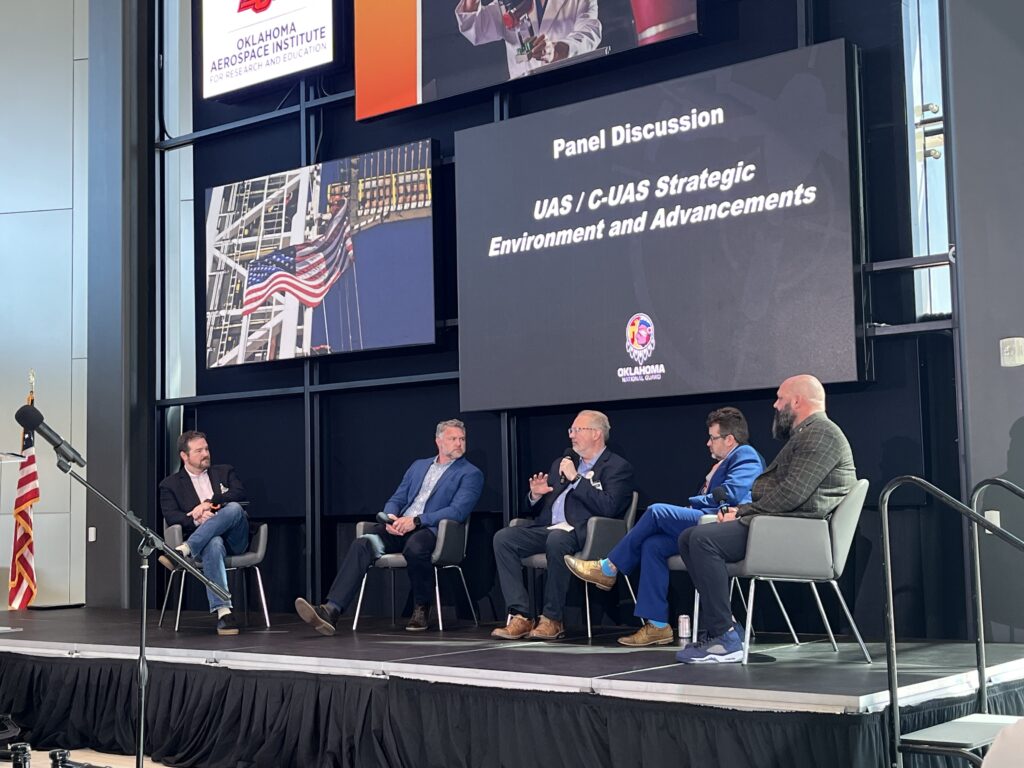
Vigilant Aerospace CEO Kraettli L. Epperson participated in the Oklahoma National Guard Counter-Uncrewed Aircraft Systems (C-UAS) Symposium last week in Oklahoma City. Following a keynote speech by Dr. Jamey Jacobs, Executive Director of Oklahoma State University’s Oklahoma Aerospace Institute for Research and Education (OAIRE), Epperson spoke on a panel addressing the counter-UAS strategic environment and current capability needs.
The symposium convened defense, government, academic, and industry stakeholders. Topics included the evolving threat landscape, operational requirements, and the practical realities of deploying counter-UAS systems at scale.
Panel Themes: Sensing, Identification, and Scalable Deployment
Across the discussion, three technical themes dominated: detection, identification, and integration.
First, the panel focused on layered sensing. Counter-UAS operators need reliable detection across varied environments. That often requires multiple sensor types working together, not a single source.
Second, the panel emphasized identification as a core requirement. Cooperative data sources, including Remote ID and ADS-B In, can accelerate identification. They can also reduce ambiguity during response decisions. However, panel discussion also acknowledged the latency and reception limits of cooperative signals.
Third, the panel returned to scale. Counter-UAS is expanding beyond a small number of protected sites. That shift increases pressure on affordability, deployability, and sustainment.
Vigilant Aerospace’s Responses: Requirements that Translate to Field Use
Epperson described counter-UAS as a distributed need. That view drives what capabilities are required in the current moment, including:
Deployability and modularity. Systems must be portable and adaptable. Site constraints vary widely across facilities and missions. Modular sensor integration supports that variability.
Cooperative identification plus non-cooperative tracking. Epperson underscored the value of Remote ID as operations expand. The company also stressed the need to track non-cooperative aircraft. Real-world facility protection cannot assume full compliance.
Address urban complexity. Urban environments increase detection challenges. Epperson noted that additional sensing approaches may be required, giving acoustic sensing as one example.
Low cost and footprint. As adoption expands, cost becomes a gating factor. Discreet installations also matter for many civil sites. Persistent coverage must be achievable without high sustainment burden.
Panelists and Moderation
The panel was moderated by Craig Mahaney of DronePort Network. Panelists included Dr. Jamey Jacob of OAIRE, Col. (Ret.) Drew Allen of the University of Oklahoma’s Oklahoma Aerospace Defense Innovation Institute (OADII), and Ryan Bransford of U.S. Army DEVCOM’s Ground & Ocean Systems and Technology (GOST) office.
About the C-UAS Symposium
The Oklahoma Army National Guard Counter-Uncrewed Aircraft Systems (C-UAS) Symposium is a two-day forum focused on counter-UAS policy, operational planning, and technology needs. It brings together defense, government, academic, and industry participants to address domestic protection requirements and evolving counter-UAS missions.
 Vigilant Aerospace is the leading developer of multi-sensor detect-and-avoid and airspace management software for uncrewed aircraft systems (UAS or drones). The company’s product, FlightHorizon, is based on two NASA patents and uses data from multiple sources to display a real-time picture of the air traffic around a UAS and to provide automatic avoidance maneuvers to prevent collisions. The software is designed to meet industry technical standards, to provide automatic safety and to allow UAS to safely fly beyond the sight of the pilot. The software has won multiple industry awards and the company has had contracts and users at NASA, the FAA, the U.S. Department of Defense and with a variety of drone development programs. Visit our website at www.VigilantAerospace.com