
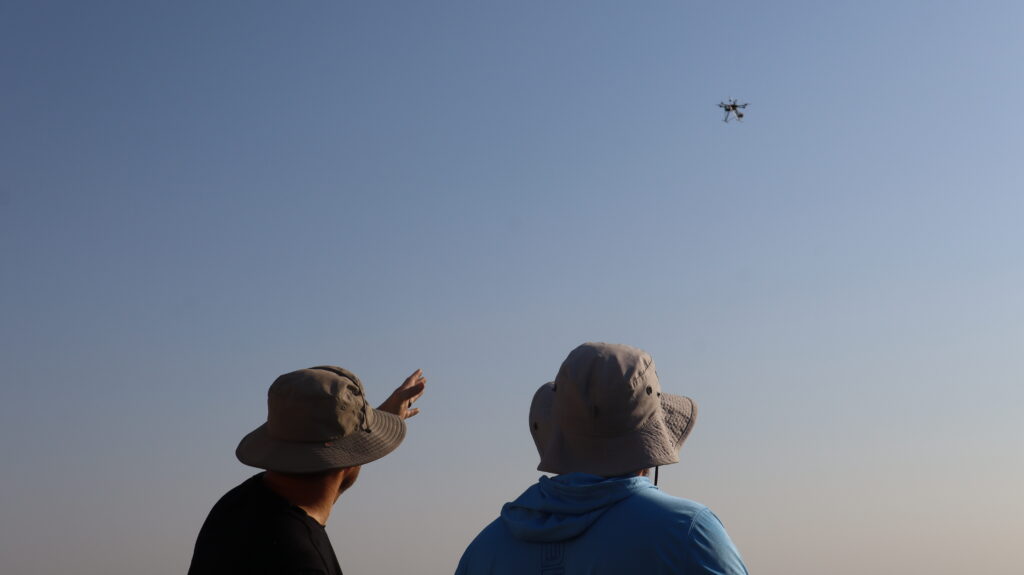
Vigilant Aerospace Systems has completed a new series of ground and flight tests focused on improving airborne radar tracking for its FlightHorizon PILOT-M onboard detect-and-avoid system.
FlightHorizon PILOT-M uses ADS-B In and onboard radar to track cooperative and non-cooperative aircraft, evaluate potential conflicts and provide avoidance guidance to a remote pilot or integrated autopilot.
The testing is part of a $1 million development project supported in part by the Oklahoma Center for the Advancement of Science and Technology (OCAST) through its Industry Innovation Program. The project is being conducted in collaboration with Oklahoma State University’s Oklahoma Aerospace Institute for Research and Education (OAIRE).
The latest work evaluated how effectively the system filters radar clutter when the sensor is exposed to movement and vibration. These conditions are unavoidable when radar is installed on an uncrewed aircraft system (UAS), making them an important consideration for reliable onboard detect-and-avoid (DAA).
Testing Radar Filtering Under Controlled Motion
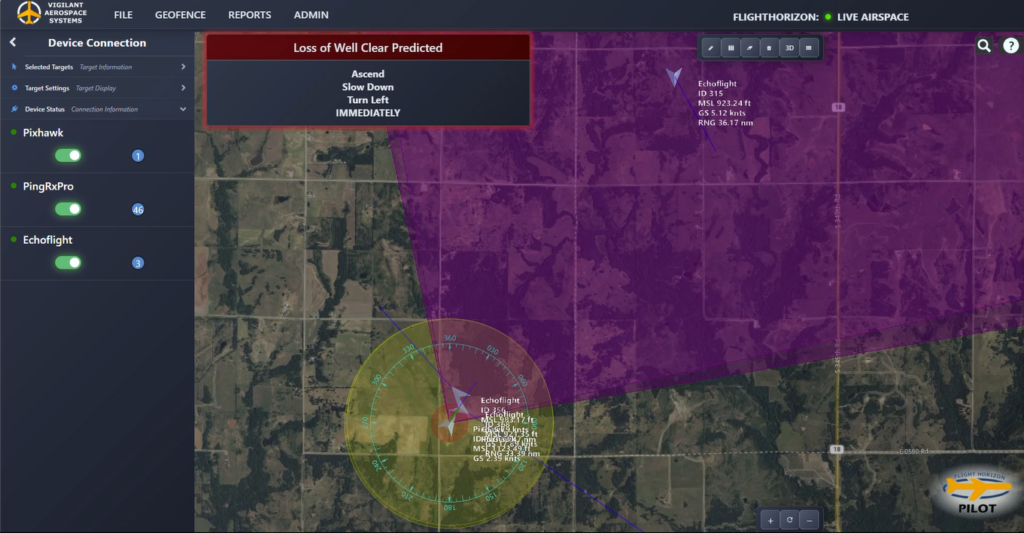
The first phase of the recent testing placed the radar on an elevated mast in heavy wind. The resulting motion provided a controlled way to evaluate the system’s filtering performance against a ground-level baseline.
Radar installed on an aircraft must distinguish real airborne traffic from unwanted returns generated by the ground, vegetation, buildings and other objects. Sensor movement and vibration add complexity because stationary objects can appear to shift between radar updates. Effective filtering must remove these unwanted tracks without filtering out actual aircraft.
During the mast testing, wind-induced movement introduced sensor motion and substantial ground clutter. The filtering process rejected unwanted tracks while the system successfully tracked multiple Cessna 172-class aircraft at distances of approximately two kilometers.
Moving the Radar From the Mast to the Air
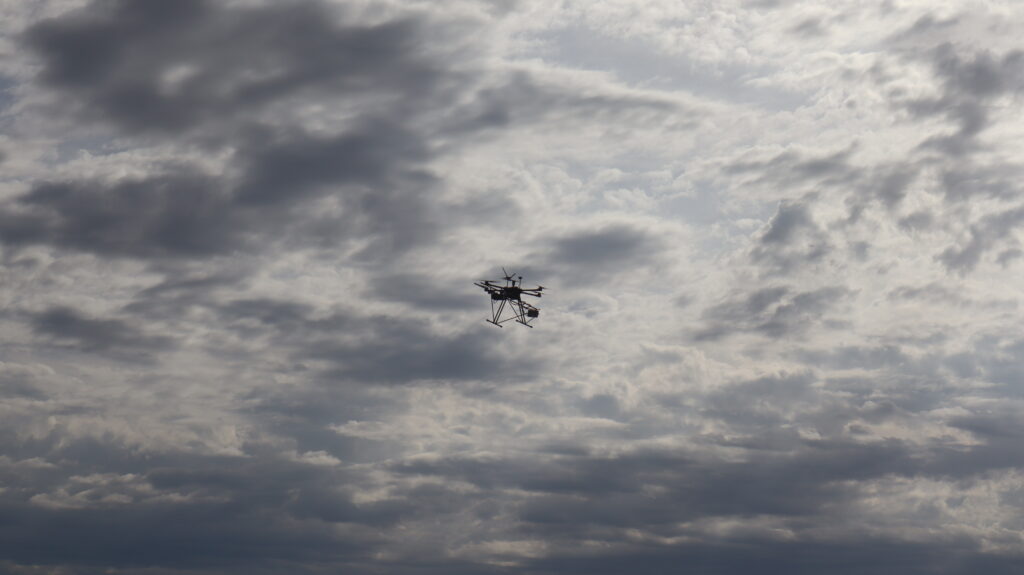
Following the ground filtering test, the team installed the radar and supporting systems on a hexacopter for airborne evaluation. The aircraft serves as a rapid-development test platform for evaluating onboard sensors, computing, communications, data flow and power systems before transitioning the technology to a larger fixed-wing UAS.
The airborne test introduced vibration from the propellers and airframe, along with movement relative to the ground. FlightHorizon PILOT-M operated onboard the aircraft and relayed radar tracks to the ground, allowing the development team to evaluate which returns passed through the filtering process and appeared on the system display.
Initial results showed that the filters continued to perform effectively under actual flight vibration. Current development work is focusing on the side-to-side motion of the hexacopter, which creates a different clutter pattern as the radar changes position and orientation relative to the ground.
A fixed-wing aircraft operating in steady, level flight is expected to experience less lateral movement than the hexacopter. Testing against the more dynamic motion of the smaller platform, however, gives the development team an opportunity to improve filtering across a broader range of operating conditions.
Supporting Onboard Detect-and-Avoid Development
This testing advances the broader FlightHorizon PILOT product family, which is designed to provide onboard air traffic tracking, conflict evaluation and avoidance guidance for UAS.
FlightHorizon PILOT-C provides cooperative traffic awareness using ADS-B In, while FlightHorizon PILOT-M adds onboard radar for tracking non-cooperative aircraft. Because the current tests focus on airborne radar performance, they directly support development of the radar-enabled PILOT-M configuration.
The latest work builds on earlier project milestones involving autopilot integration, onboard computing, cooperative and non-cooperative traffic inputs, ground-station displays and testing on multirotor and fixed-wing aircraft. Vigilant Aerospace previously published a project and flight-testing update describing these developments.
The next stages of the project will continue tuning the radar-filtering process and preparing the system for testing on a larger fixed-wing UAS. Data collected through this work will support system refinement, platform integration and continued evaluation against applicable DAA technical standards.
About the Oklahoma Center for the Advancement of Science and Technology

The Oklahoma Center for the Advancement of Science and Technology is Oklahoma’s state agency focused on technology-based economic development. Its Industry Innovation Program provides funding for Oklahoma companies developing technologies with commercial applications and potential economic impact in fields including aerospace, autonomous systems and defense.
About the Oklahoma Aerospace Institute for Research and Education

The Oklahoma Aerospace Institute for Research and Education is an institute within Oklahoma State University that coordinates aerospace research, testing and workforce-development programs. OAIRE supports partnerships among industry, academia, government and the military, with capabilities spanning autonomous systems, advanced air mobility, airspace integration and flight testing.
 Vigilant Aerospace is the leading developer of multi-sensor detect-and-avoid and airspace management software for uncrewed aircraft systems (UAS or drones). The company’s product, FlightHorizon, is based on two NASA patents and uses data from multiple sources to display a real-time picture of the air traffic around a UAS and to provide automatic avoidance maneuvers to prevent collisions. The software is designed to meet industry technical standards, to provide automatic safety and to allow UAS to safely fly beyond the sight of the pilot. The software has won multiple industry awards and the company has had contracts and users at NASA, the FAA, the U.S. Department of Defense and with a variety of drone development programs. Visit our website at www.VigilantAerospace.com