As we reflect on 2025 and look ahead to 2026, we are energized by the momentum across the uncrewed aircraft systems (UAS) and advanced air mobility (AAM) industries. The past year marked a clear inflection point as the sector continued its accelerated shift toward integrated airspace operations and automated safety, supported by growing confidence that scalable, routine flight operations are now within reach.
Across the industry, this shift has created renewed urgency and strong market pull for autonomous safety solutions. Operators, regulators, and infrastructure providers are increasingly focused on ground-based and onboard systems that combine multiple sensors, advanced edge computing, and sophisticated algorithms to deliver intelligent, integrated, and automatic safety capabilities. These solutions are needed both locally at remote deployment or operations sites and onboard the aircraft to enable greater situational awareness, better coordination, and increasingly autonomous safety decision-making.
A New Phase in Integrated Airspace Safety
At Vigilant Aerospace, we saw heightened emphasis among government and commercial stakeholders on validated, standards-aligned safety systems. At the same time, long-anticipated commercial programs began coming online, FAA rulemaking progressed, and international competition continued to accelerate, making 2025 a defining year for planning, growth, and execution.
In response, Vigilant continued to meet evolving requirements with FlightHorizon PILOT, our onboard detect-and-avoid (DAA) system, and FlightHorizon TEMPO, our networked, ground-based airspace management platform. Throughout the year, we expanded deployments for testing and operational use across civil, defense, and AAM customers, helping partners move from evaluations into broader operational planning.
Much of 2025 built on the momentum established in 2024, including continued progress on the first phase of Oklahoma’s new large-scale airspace management system, centered at the Oklahoma Air and Space Port in western Oklahoma. This milestone reflects a broader trend: regional investments in integrated airspace safety infrastructure to enable scalable operations for UAS and emerging AAM aircraft. Equally important was the continued advancement of FlightHorizon PILOT, originally customized for military use in 2024 under an Air Force Research Laboratory contract, and now increasingly in demand among civilian and commercial operators as well.
Changing Frontiers
We also saw new frontiers open rapidly for the commercial small UAS sector. With the FAA’s publication of the Part 108 Notice of Proposed Rulemaking (NPRM), aimed primarily at enabling beyond visual line of sight (BVLOS) flight for small UAS, the industry now has a tangible pathway toward a transformation comparable to the impact of Part 107 in 2016. In parallel, the Part 146 NPRM outlines a path forward for networked air traffic surveillance services of the kind Vigilant Aerospace has been developing and deploying for years. Together, these are strong signals of advancement and opportunity, and they reinforce the need for trusted, validated, standards-aligned safety capabilities across the ecosystem.
In 2025, we also saw significant growth in demand for onboard detect-and-avoid systems, driven in part by increasing development and operational use of Group II and Group III UAS. These aircraft are enabling longer flight durations and carrying the payload required for onboard safety systems, and the industry is increasingly recognizing that onboard DAA will be essential to unlocking routine, scalable access to U.S. airspace. For Vigilant Aerospace, this positions FlightHorizon PILOT as a key element in complete operational strategies for a broad range of UAS and AAM operators and manufacturers, and we are seeing increasing interest in our ability to integrate, deliver, and support these onboard solutions.
Many years of planning and development quietly came to fruition over the past year, and we anticipate more of that work will be ready to announce publicly in 2026.
Most importantly, we want to thank our customers, partners, and collaborators for their trust, shared commitment, and continued leadership in advancing safe, scalable flight. The progress of 2025 reflects what is possible when industry and government work together with a common mission: enabling integrated airspace operations that are not only innovative, but demonstrably safe. We look forward to building on this momentum with you in 2026, and to delivering the systems, standards alignment, and operational readiness that will define the next era of UAS and AAM growth.
Below are selected highlights from Vigilant Aerospace’s work in 2025.
Major Projects
Launch of FlightHorizon TEMPO and Large-Scale Radar Network for Airspace Management at Oklahoma Air and Space Port
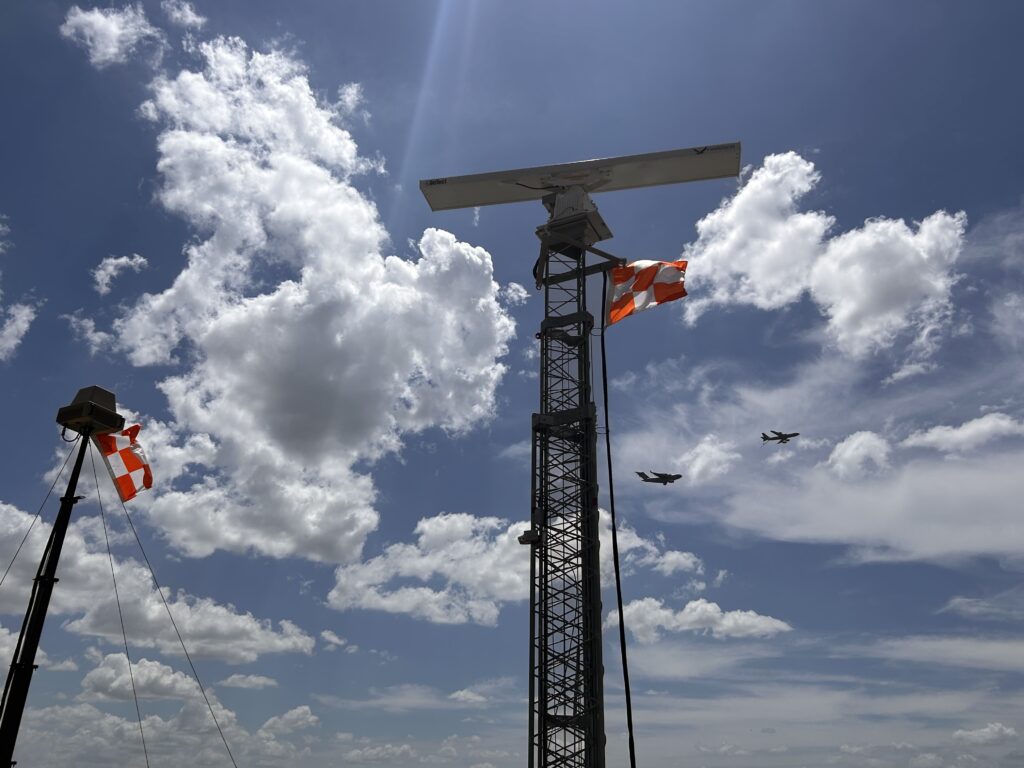
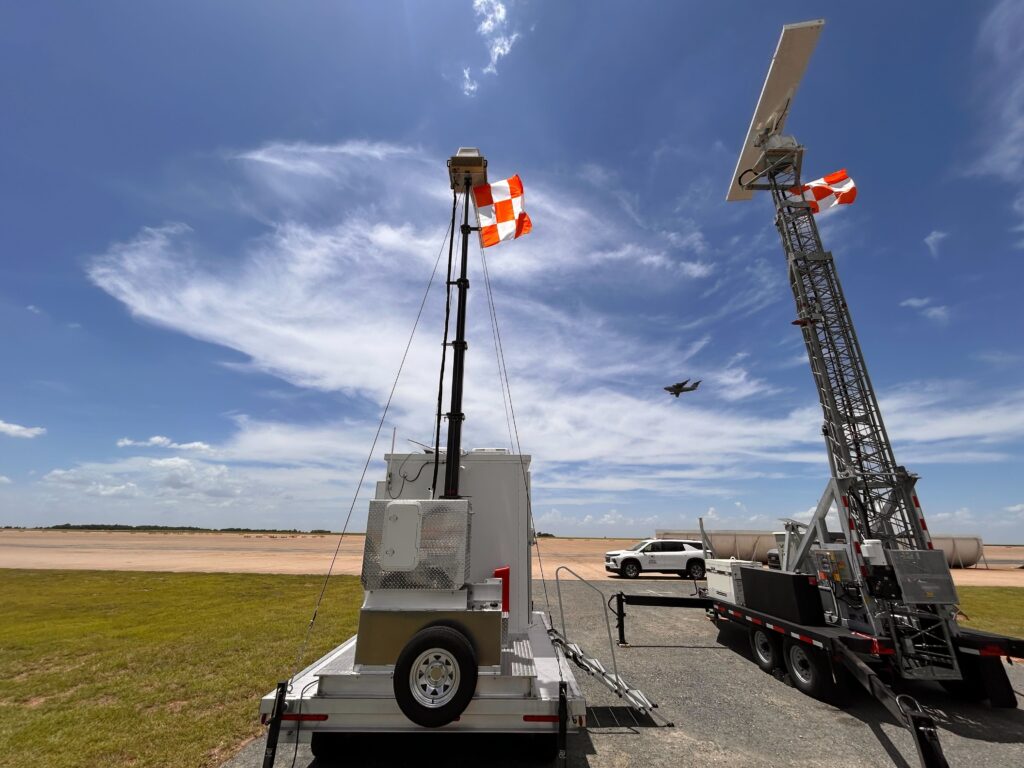
A Harrier 2D radar deploying at Clinton-Sherman Airport- providing a comprehensive view of the airspace around it
Vigilant Aerospace worked with theOklahoma Department of Aerospace and Aeronautics (ODAA) to deploy multiple radars supporting FlightHorizon TEMPO at Clinton-Sherman Airport. The Clinton-Sherman Airport is also one of only 14 FAA-licensed spaceports in the United States. The new infrastructure supports long-range UAS testing and expanded airspace awareness.
This state-level investment is aimed at enabling extended beyond visual line of sight (BVLOS) operations. It also supports broader autonomous system deployment in Oklahoma.
In June, Vigilant Aerospace was selected as a vendor under the U.S. Air Force’s Enterprise-Wide Agile Acquisition Contract (EWAAC). The indefinite-delivery, indefinite-quantity contract runs through 2031. The U.S. Air Force has awarded 122 companies positions this year on the $46 billion EWAAC as part of the fourth selection round to the procurement contract meant to support the rapid development of novel weapons capabilities.
EWAAC supports research and development, test and evaluation, prototyping, system modeling, modernization, and fielding. The selection positions Vigilant Aerospace to support accelerated delivery of advanced digital and autonomous defense capabilities.
FlightHorizon TEMPO Deployed for U.S. Air Force and Air National Guard Collaboration at Gorman Field with UND Aerospace
Military and UND Leaders at Gorman Field UAS Test Range (Photo by Joe Banish, UND Today)
Vigilant Aerospace collaborated with the University of North Dakota (UND), U.S. Air Force, and the North Dakota Air National Guard on counter-UAS exercises and applied research at UND’s Gorman Field UAS Test Range. Focused on simulating real-world applications, the US Air Force and Air National Guard flew various types of UAS in airspace monitored live by FlightHorizon TEMPO. The work demonstrated real-time airspace management in a complex, high-traffic environment. It also supported broader experimentation around interoperability, integration, and scalability in shared airspace.
Vigilant Aerospace Deploys Radar, Remote ID at Skyway Range Droneport in Tulsa
DeTect 7360 radar deployed at Skyway Range in Tulsa
Vigilant Aerospace expanded airspace awareness at Skyway Range in Tulsa with the deployment of radar, ADS-B In, and Remote ID integration to support advanced BVLOS testing and autonomous flight operations. The deployment is a continuation of a 2-year FlightHorizon TEMPO pilot project with Skyway Range. The system uses FlightHorizon ALERT and TEMPO to support general aviation, UAS, and AAM operations by improving visibility and coordination in shared airspace.
Vigilant Aerospace Comments on FAA BVLOS NPRM for Part 108 & Part 146
Vigilant Aerospace submitted detailed comments on the FAA’s proposed Part 108 and Part 146 BVLOS framework, outlining technical and operational considerations for safely scaling routine beyond visual line of sight operations in shared airspace. The comments argue that clear, performance-based standards are essential to avoid limiting BVLOS operations to a narrow set of technologies.
In addition to project work, Vigilant Aerospace participated in industry conferences and contributed to aerospace publications throughout the year. Engagement with regulators, researchers, and technology partners remains central to the company’s role in the aerospace ecosystem.
Presentation on DAA for Airspace Safety at UAS Summit & Expo 2025
Kraettli L. Epperson presenting at UAS Summit and Expo, October 14th, 2025 (Courtesy: Mike Hess Photography)
At the UAS Summit & Expo, Vigilant Aerospace CEO Kraettli L. Epperson presented on the role of DAA and airspace management in enabling routine uncrewed operations. The presentation, called Airspace Management with Detect-and-Avoid for UAS in 2025: System Components and Best Practices with Real-World Examples, focused on real-world deployments of FlightHorizon systems.
It also addressed the regulatory shift toward integrated airspace under proposed FAA Part 108 and Part 146 rules. Emphasis was placed on standards-compliant, automated safety systems as operations scale beyond waiver-based models.
How-To Workshop on ASTM DAA Standards at AUVSI XPONENTIAL 2025
In an ASTM workshop, Epperson and Censys Director of Regulatory Affairs Rob Knochenhauer presented on practical approaches to demonstrating DAA standards compliance for BVLOS operations at XPONENTIAL 2025. The session, called DAA Standards, Compliance, and Approvals – a “How To” (Do It Right) Workshop, focused on translating ASTM and RTCA standards into regulator-ready safety cases.
The presentation highlighted the use of real-world data and test evidence. It also addressed how operators can move from waiver-based flights toward routine, rules-based approvals.
Industry Presentation on Scaling UAS Flights at American Institute of Aeronautics and Astronautics (AIAA) 2025 Event
Epperson presented on scaling integrated airspace for uncrewed and autonomous aircraft at AIAA 2025. The presentation was called Development of a Distributed, Multi-Sensor Uncrewed Aircraft Traffic Management System with Automatic Detect-And-Avoid Track Correlation. It outlined advances in multi-sensor DAA, autonomous conflict resolution, and distributed airspace management architectures.
It also highlighted extensive field testing and standards-aligned system design supporting safe integration of UAS and AAM operations in increasingly congested airspace.
Vigilant Aerospace CEO Guest Article in UAS Magazine: Standards-Based Detect-and-avoid Is Central to Scaling Drone Operations
Epperson outlined the industry’s shift from case-by-case waivers to standardized rules for uncrewed aircraft system integration into the National Airspace in a guest article for UAS Magazine. The article, called Advancing Drone Operations, highlighted the role of standards-aligned DAA both on the ground and on board UAS and lays out a roadmap for what the industry might look like as these rules are implemented. Epperson writes,
“Getting to routine flights of both crewed and uncrewed aircraft isn’t about one breakthrough; it’s about aligning sensing, software, and industry technical standards and then proving they work together to provide safety.”
Director of Business Development Guest Article on What Determines True DAA in Military Embedded SystemsMagazine
In a guest article for Military Embedded Systems, Vigilant Aerospace Director of Business Development Zach Peterson examined what constitutes true detect-and-avoid capability. The article, called Safety in numbers – Standards-compliant multisensor detect-and-avoid, emphasized sensor fusion, automated conflict resolution, and alignment with ASTM and RTCA standards. Instead of simply alerting or telling aircraft to land, DAA systems need to modify aircraft routes with minimal interruption.
Advanced Air Mobility International Interview with Vigilant Aerospace CEO on scaling DAA systems
In an interview with AAM International, Epperson discusses how Vigilant Aerospace’s DAA and airspace management systems support AAM applications. The article, called How Vigilant Aerospace is Deploying DAA & Airspace Management Systems for AAM Sector, focused on adapting FlightHorizon systems for scalability through onboard DAA and modular architectures. The interview addressed integration of autonomous and piloted AAM aircraft into shared airspace as regulatory frameworks mature. Epperson says in part,
“We keep that core DAA function in all of our software… By doing that we’re able to develop and deploy a system that is fully compatible and ready to support a wide variety of AAM aircraft and AAM operations.”
Innovate That Podcast with Lt. Governor Matt Pinnell and Vigilant Aerospace CEO on Oklahoma’s Role in Aerospace Industry
Epperson joined Oklahoma Lt. Governor Matt Pinnell on his Innovate That podcast to discuss how airspace safety, autonomy, and state-level leadership are shaping the future of aviation. Epperson also explores what makes Oklahoma the place to be for aerospace research, saying,
“Oklahoma has created an environment where advanced aviation technologies can move from research into real-world operations faster than almost anywhere else.”
Aircraft Owners & Pilot Association on How UAS Can Share Airspace With General Aviation
The Aircraft Owners & Pilot Association highlighted Vigilant Aerospace’s collaboration with UND Aerospace in an article called GA-friendly drone management. Focusing on how integrated drone management and DAA systems can address general aviation concerns by improving visibility, predictability, and safety for crewed aircraft operating alongside UAS in shared airspace.
Drone Radio Show Interview with Vigilant Aerospace CEO On Economic growth From Aerospace Infrastructure
Epperson sat down with Randy Goers, host of The Drone Radio Show, to talk about how building aerospace infrastructure can drive regional economic development, while supporting long-term industry growth. He emphasizes participation from the community, saying
“Drones become an economic development tool when communities invest in the airspace, safety systems, and policies that allow real operations to happen.”
In 2025, Vigilant Aerospace expanded its industry leadership with Zach Peterson’s election as Vice Chair of the North Dakota Unmanned Autonomous Systems Council, strengthening collaboration across government, academia, and industry on UAS policy and deployment. Vigilant also continued active leadership within the National Defense Industrial Association Northern Tier Chapter, where Peterson serves as Vice President on the board, supporting a chapter recognized this year for outstanding performance in advancing the defense industrial base. Vigilant Aerospace also maintained engagement with the AUVSI Great Plains Chapter through Peterson’s role as secretary, contributing to regional discussions on regulatory policy, operational requirements, and workforce development for uncrewed aviation.
ASTM Contributions
Vigilant Aerospace entered its seventh year of participation in the ASTM International F38 Committee on Uncrewed Aircraft Systems, contributing operational and technical expertise to standards development for detect-and-avoid and airspace integration. This work supports performance-based requirements that inform regulatory frameworks and enable safe integration of crewed and uncrewed aircraft in shared airspace.
Looking Ahead
As 2025 comes to a close, the focus remains consistent. Deliver real-world capability. Support scalable operations. Continue building the technical foundations required for routine, integrated uncrewed flight.
About Vigilant Aerospace Systems
Vigilant Aerospace is the leading developer of multi-sensor detect-and-avoid and airspace management software for uncrewed aircraft systems (UAS or drones). The company’s product, FlightHorizon, is based on two NASA patents and uses data from multiple sources to display a real-time picture of the air traffic around a UAS and to provide automatic avoidance maneuvers to prevent collisions. The software is designed to meet industry technical standards, to provide automatic safety and to allow UAS to safely fly beyond the sight of the pilot. The software has won multiple industry awards and the company has had contracts and users at NASA, the FAA, the U.S. Department of Defense and with a variety of drone development programs. Visit our website at www.VigilantAerospace.com












 Vigilant Aerospace is the leading developer of multi-sensor detect-and-avoid and airspace management software for uncrewed aircraft systems (UAS or drones). The company’s product, FlightHorizon, is based on two NASA patents and uses data from multiple sources to display a real-time picture of the air traffic around a UAS and to provide automatic avoidance maneuvers to prevent collisions. The software is designed to meet industry technical standards, to provide automatic safety and to allow UAS to safely fly beyond the sight of the pilot. The software has won multiple industry awards and the company has had contracts and users at NASA, the FAA, the U.S. Department of Defense and with a variety of drone development programs. Visit our website at www.VigilantAerospace.com