
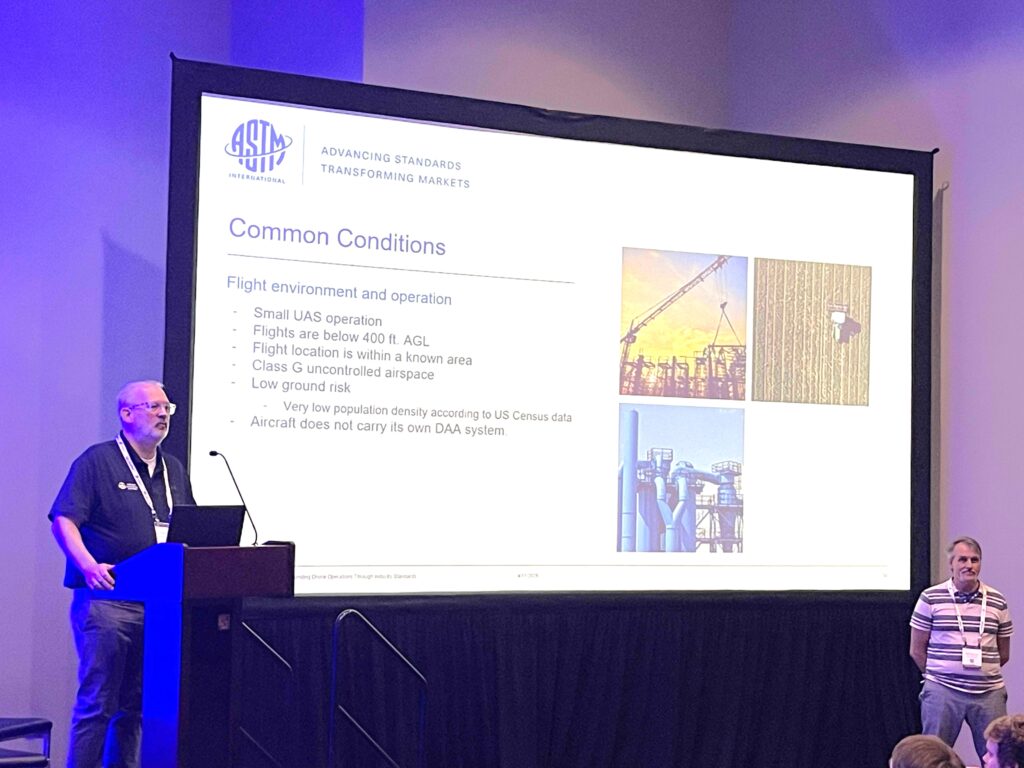
Vigilant Aerospace Systems CEO Kraettli L. Epperson made a presentation that outlined a practical, evidence-driven approach to translating industry standards into regulator-ready safety cases for ‘beyond visual line of sight’ (BVLOS) drone flights. The segment was delivered with co-presenter Rob Knochenhauer of Censys at the co-located ASTM workshop DAA Standards, Compliance, and Approvals – a “How To” (Do It Right) Workshop at AUVSI XPONENTIAL 2025.
The section presented by Epperson and Knochenhauer on May 19th was titled “Exercise Use Case: Putting It All Together.” It capped off the ASTM workshop with a practical, real-world use case analysis on how to use ASTM technical standards to meet specific operational and regulatory requirements for detect-and-avoid performance and safety when flying drones beyond visual line-of-sight.
Epperson presented with Censys Director of Regulatory Affairs Rob Knochenhauer, who brought insights from his company’s long-term experience in operating inspection drones beyond visual line-of-sight for utilities nationwide.
ASTM International is a global standards development organization that publishes voluntary consensus technical standards across many industries, including aviation and uncrewed aircraft systems (UAS). Vigilant Aerospace has been a part of the ASTM since 2018 and is a contributing member of their F38 standards committee.
A Practical Example
Epperson and Knochenhauer’s section focused on how to apply ASTM F3442 standards to real life operations using a single operational use case. ASTM F3442 is an industry standard that defines performance requirements for DAA systems used by uncrewed aircraft to identify crewed aircraft, issue timely alerts, and execute maneuvers to remain well clear in shared airspace.
They presented an end-to-end example of applying ASTM F3442 to a small uncrewed aircraft operation. The use case assumed flights below 400 feet above ground level in Class G airspace. It also assumed no onboard DAA hardware. This constraint reflects many current commercial operations.
They evaluated multiple mission types, including crop management, pipeline inspection, and small package delivery. Each scenario introduced different air risk profiles. Agricultural aircraft and low-altitude general aviation traffic were key non-cooperative threats. The presenters showed how DAA addresses these risks when paired with strategic mitigations.
Their section also focused on system architecture and decision logic. They walked through how cooperative surveillance, radar sensing, and DAA software interact. Visual examples showed ownship-centric alerting volumes, well clear thresholds, and avoidance timing. These elements tied directly back to ASTM F3442 DAA functions.
Testing and validation were also addressed. Epperson and Knochenhauer highlighted field testing using “wagon wheel” flight test patterns and large-scale simulations. These methods demonstrate how performance evidence is built for regulatory review. The discussion emphasized documentation and traceability rather than theoretical compliance.
They concluded by addressing implementation. Operators must package DAA capability within a complete operational approval request. Tactical risk mitigation must be supported by strategic awareness of airspace, traffic patterns, and nearby aviation activity. They ended by emphasizing that regulators evaluate the full safety case, not individual components in isolation.
Read Epperson and Knochenhauer’s section of the workshop below.
Presentation
Other Speakers
The workshop addressed other challenges with showing conformity to industry standards when seeking BVLOS approvals. The agenda followed the full lifecycle of compliance, from regulatory context to requirements, modeling, testing, and operational approval. Each segment was delivered by subject matter experts with direct experience supporting regulatory submissions.
Andy Thurling of DroneUp opened the session with an overview of the FAA standards landscape. He outlined how federal regulations, ASTM standards, and RTCA documents intersect. Alex Fomenko of DroneUp then focused on deriving system requirements from ASTM F3442. His section emphasized translating broad standard language into verifiable product requirements.
Andrew Kriz of the MITRE Aviation Program and Andrew Weinert of MIT Lincoln Laboratory addressed modeling and simulation. Their discussion covered encounter generation, risk ratios, and the role of Monte Carlo analysis. Kyle Ryker of ASSURE followed with guidance on flight test campaign design. His section explained how simulation and flight testing align within the ASTM testing framework.
Jon Damush of uAvionix and Kyle Roh of Nightingale Security presented an operator perspective. They described how DAA systems perform in real deployments. Their examples highlighted scaling from small pilot programs to dense urban operations.
Workshop Presenters and Organizations
The workshop featured the following presenters:
- Andy Thurling, DroneUp
- Alex Fomenko, DroneUp
- Andrew Kriz, MITRE Aviation Program
- Andrew Weinert, MIT Lincoln Laboratory
- Kyle Ryker, ASSURE
- Jon Damush, uAvionix
- Kyle Roh, Nightingale Security
- Rob Knochenhauer, Censys
- Kraettli Epperson, Vigilant Aerospace Systems
- Federal Aviation Administration representatives
About ASTM
ASTM International is a globally recognized standards development organization that develops and publishes voluntary consensus technical standards for a wide range of industries. In aviation and uncrewed aircraft systems (UAS), ASTM committees develop standards that address aircraft performance, safety, airworthiness, and operational requirements, including key frameworks supporting detect-and-avoid (DAA) systems and beyond visual line of sight (BVLOS) operations.
About XPONENTIAL
XPONENTIAL is an annual global conference and exhibition for uncrewed systems and autonomy, bringing together industry, government, and research leaders across aviation, maritime, and ground domains. The event is organized by AUVSI and serves as a forum for policy discussions, technical education, and technology demonstrations related to autonomous systems.
 Vigilant Aerospace is the leading developer of multi-sensor detect-and-avoid and airspace management software for uncrewed aircraft systems (UAS or drones). The company’s product, FlightHorizon, is based on two NASA patents and uses data from multiple sources to display a real-time picture of the air traffic around a UAS and to provide automatic avoidance maneuvers to prevent collisions. The software is designed to meet industry technical standards, to provide automatic safety and to allow UAS to safely fly beyond the sight of the pilot. The software has won multiple industry awards and the company has had contracts and users at NASA, the FAA, the U.S. Department of Defense and with a variety of drone development programs. Visit our website at www.VigilantAerospace.com