
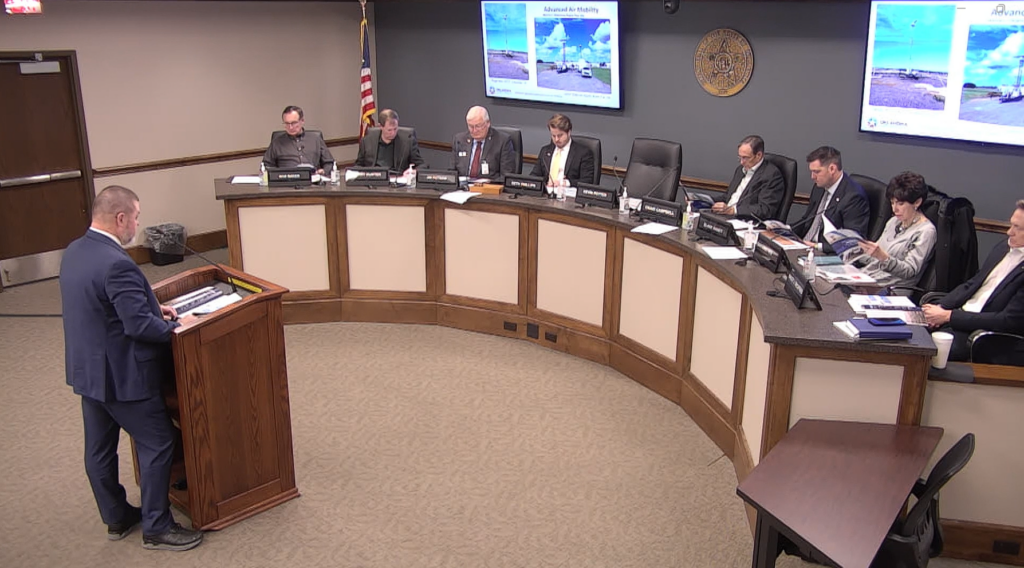
In a recent Oklahoma Department of Aerospace and Aeronautics (ODAA) commission meeting, Doug Wood, State Manager for Advanced Air Mobility (AAM), outlined five statewide priorities for uncrewed aircraft systems (UAS) and AAM activity including the FlightHorizon TEMPO airspace management system in western Oklahoma at the Clinton-Sherman Airport. He summarized progress on the radar-enabled flight test infrastructure being deployed and future plans for the system.
The state’s UAS and AAM priorities share Vigilant Aerospace’s main focus: Airspace safety, detect-and-avoid between crewed and uncrewed aircraft, airspace management for beyond visual line of sight (BVLOS) flight of uncrewed aircraft and readiness to provide airspace safety throughout Oklahoma.
Radar-Enabled Test Infrastructure in Western Oklahoma
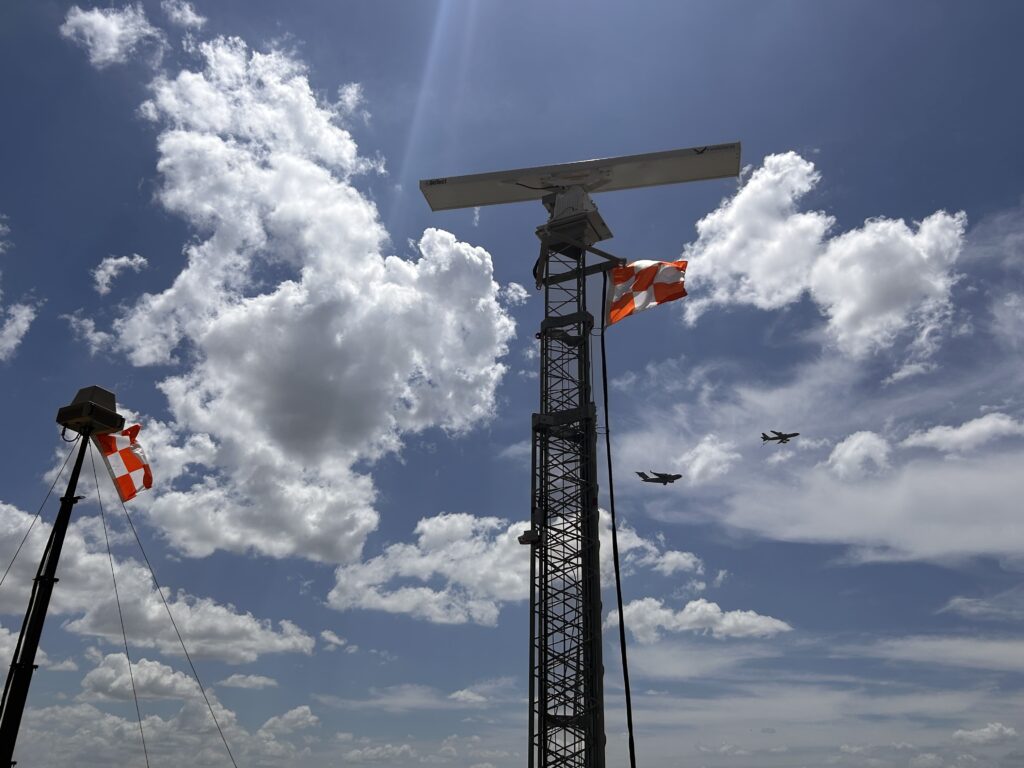
Wood highlighted the Clinton-Sherman Airport radar test site effort, citing Vigilant Aerospace as the system integrator and manager and DeTect as the radar hardware provider. Phase I of the project includes three radars that were installed in early October and are already gathering data.
He identified the two main radar locations supporting the corridor as Clinton-Sherman Airport in Burns Flat and an Oklahoma Department of Transportation (ODOT) maintenance site in Roger Mills County. Wood closed with plans to expand the corridor, with four additional radars to increase coverage and overall testing capacity in Western Oklahoma.
Five Priorities for ODAA Projects in Western Oklahoma
Wood described five priorities intended to guide how Oklahoma evaluates UAS and AAM investment and strategy:
1) Economic Growth
Wood emphasized commercial growth as a top priority for the state’s investment in UAS and AAM programs. For Vigilant Aerospace, commercial scaling increases demand for consistent airspace safety, airspace logging, and flight documentation. Those elements become critical when operators move from demonstrations to routine commercial flight of autonomous aircraft.
2) Infrastructure Development
Wood highlighted infrastructure development and the importance of having capability in place before companies arrive. This especially applies to installing radars, ADS-B receivers, airspace management systems and data networks.
He also noted that Oklahoma has established and increased a state revolving fund to support UAS and AAM infrastructure projects. Airspace management software support and radar coverage are important parts of the infrastructure that UAS and AAM companies consider before deciding where to test and operate.
3) Regulatory Framework
Wood cited regulatory compliance and coordination with the FAA as an important activity to advance the UAS and AAM sectors, with an emphasis on enabling safe operations under current and emerging FAA rules. As demand for BVLOS activity grows, regulators will expect defensible safety cases supported by surveillance inputs such as radar and ADS-B In, along with other sensors, to establish a reliable air picture and prevent conflicts.
Wood also referenced Oklahoma’s participation in the Advanced Air Mobility Multi-State Collaborative and associated position papers. That effort will lead to increasing alignment on expectations for infrastructure, roles, and operating practices across the nation.
4) Education and Training
Wood identified education and training as a priority tied to workforce development to support the UAS and AAM sectors. For Vigilant Aerospace, workforce readiness affects business siting decisions and state competitiveness. Range operations and safety oversight require trained personnel who can operate systems, interpret airspace data, and maintain compliant records.
5) Public Awareness
Wood emphasized the need for public awareness and confidence in aviation safety as UAS activity expands. Public awareness is important because the FAA is currently writing the rules of the air for this new classification of aircraft and the public needs to be confident that safety standards are being maintained. Systems like Vigilant’s FlightHorizon as utilized by ODAA, help to improve safety and confidence by providing standards-compliant detect-and-avoid and airspace management and safety.
Oklahoma AAM Outlook: Forecast-Driven Readiness and Staged Investment
Wood concluded the segment discussing an Advanced Mobility Strategy Document that ODAA contributed to, in collaboration with ODOT. Based in part on a financial forecast by Nexa Capital, the plan estimates the potential scale of economic activity from the advanced mobility industry in the state through 2045.
Wood concludes that the aviation agenda outlined in the document is a progression from planning and readiness to building an industry footprint and then putting money behind it. He also emphasized the importance of upcoming FAA Part 108 rule publication expected in 2026.
Full Video
Full Transcript
Good morning, Mr. Vice Chair and Commissioners.
Director Ardies wanted me to do a quick rundown of the events that I’ve attended and some of the projects we’ve had for the last, going on the last year.
But I realize we have 3 new commissioners on board that since the last time I spoke, so I thought a quick little historical background on how we got to where we’re at before I start that part of my presentation.
I was hired in the beginning of 2022 to be the UAS program manager for the state, and that morphed later into the Advanced Air Mobility State Manager.
Shortly after I got here, Director Ardies and I sat down and we talked about what we wanted the future to look like and how we came up with our future efforts.
And so we talked about the testing, commercialization, development, and research of UAS and AAM and how that was our overarching focus and came up with five Priorities that we wanted to use going forward to kind of evaluate how that was.
The first one was obviously economic growth.
How do we promote commercial UAS and now AAM throughout the state and grow that in the tradition that we have here in Oklahoma with aviation and aerospace.
The second part of that was infrastructure development.
Obviously, to draw companies here, we need to have the infrastructure in place or being built when they arrive.
The third piece of that was regulatory framework.
Working within the regulatory framework of the FAA, but also not over regulating, working with our legislatures and then any other partners such as the governor’s office, the state legislature.
The fourth was education and training.
So we need to build out that workforce pipeline with the UAS programs at our colleges and universities and with CareerTech and other stakeholders to make sure that we can provide the workforce that these companies will need.
And then the fifth piece of that was public awareness.
Making sure that the public is aware of what we’re doing, but also keeping the public informed andkeeping the public supportive.
We have a strong tradition here in Oklahoma of aviation and aerospace and so we’re very supportive of that. And we want to make sure that as we bring UAS and AAM into the mix that we maintain that support. So that was kind of our guiding principle going forward and I think that we’ve done a good job of staying on that track.
One of the big things that we did, and I know you’ve heard some about this at previous meetings, was the Advanced Mobility Strategy.
We partnered with ODOT and created an Advanced Mobility Strategy for the state of Oklahoma and this was to kind of align with a lot of the other states that have done similar strategies. It includes an air agenda and ground agenda, but my focus obviously is on the air agenda.
Within that Advanced Mobility Strategy, it has 3 major phases that we looked at, and that is preparing for the future, ensuring that Oklahoma is ready, establishing an industry presence, and investing in that presence.
Part of this strategy was doing a financial forecast. We hired Nexa Capital to do a financial forecast that went out through 2045 and it looked at advanced air mobility as a whole.
It looked at passenger transport, cargo transport, UAS and then other adjacent markets.
They did a detailed financial forecast and some of those numbers are pretty staggering. I won’t go into all the details, but the total economic impact through 2045 was a large number.
Within that, we looked at UAS, and I think this is important because it’s relevant to some of the things we’re doing today. They tied that to anticipated FAA regulation changes, particularly the FAA’s Part 108 rule which they expect in 2026. And within that UAS market, they forecast annual capital expenditures and payroll and job growth.
Again, I’m not going to go through all those numbers here, but the purpose was to quantify the scale of opportunity.
Now I want to talk about a few of the things that I’ve been doing this last year. I’ve attended a number of events.
One of the biggest pieces of that has been our work with the Advanced Air Mobility Multi-State Collaborative. Oklahoma is a member of that collaborative. We’ve been engaged in that work, and they’ve been working on position papers. Those papers are designed to clarify federal versus state roles and responsibilities as AAM and UAS operations increase.
I think that’s going to be important going forward as states try to align on these topics.
Now, one of the tangible infrastructure projects that we have going right now is the radar test site at Clinton-Sherman.
This is something that the state funded. We ran the procurement process and selected DeTect as the radar provider and Vigilant Aerospace as the software provider. The goal was to install three radars around Clinton-Sherman to provide coverage for UAS testing.
To date, we currently have installed, on the right-hand side, those two radars are Clinton Sherman and Roger Mills. Our friends here at ODOT have graciously allowed us to place a radar at their ODOT maintenance site just north of Cheyenne at Roger Mills.
Steve Mendez, who’s the site supervisor there, has been stellar in assisting us and getting us placed out there. As much as we were placed right next to a power pole, we didn’t have to trench any power to run our shore power.
They’ve just been fantastic.
About Oklahoma Department of Aerospace and Aeronautics
The Oklahoma Department of Aerospace and Aeronautics serves as the lead government agency to support, promote, and advocate for the state’s second largest industry, aviation and aerospace. This includes providing funding, planning, programming and engineering expertise for Oklahoma’s airports and aviation infrastructure as well as ensuring the viability of the aerospace industry. The agency is responsible for the administration and/or coordination of a statewide system of airports, cooperating with and assisting local, state, and federal authorities in the development of aviation infrastructure and facilities, acting as the central resource point in state government for the up-and-coming Uncrewed Aircraft Systems and Advanced Air Mobility sector, and fostering the success of the state’s overall aerospace industry.
 Vigilant Aerospace is the leading developer of multi-sensor detect-and-avoid and airspace management software for uncrewed aircraft systems (UAS or drones). The company’s product, FlightHorizon, is based on two NASA patents and uses data from multiple sources to display a real-time picture of the air traffic around a UAS and to provide automatic avoidance maneuvers to prevent collisions. The software is designed to meet industry technical standards, to provide automatic safety and to allow UAS to safely fly beyond the sight of the pilot. The software has won multiple industry awards and the company has had contracts and users at NASA, the FAA, the U.S. Department of Defense and with a variety of drone development programs. Visit our website at www.VigilantAerospace.com