
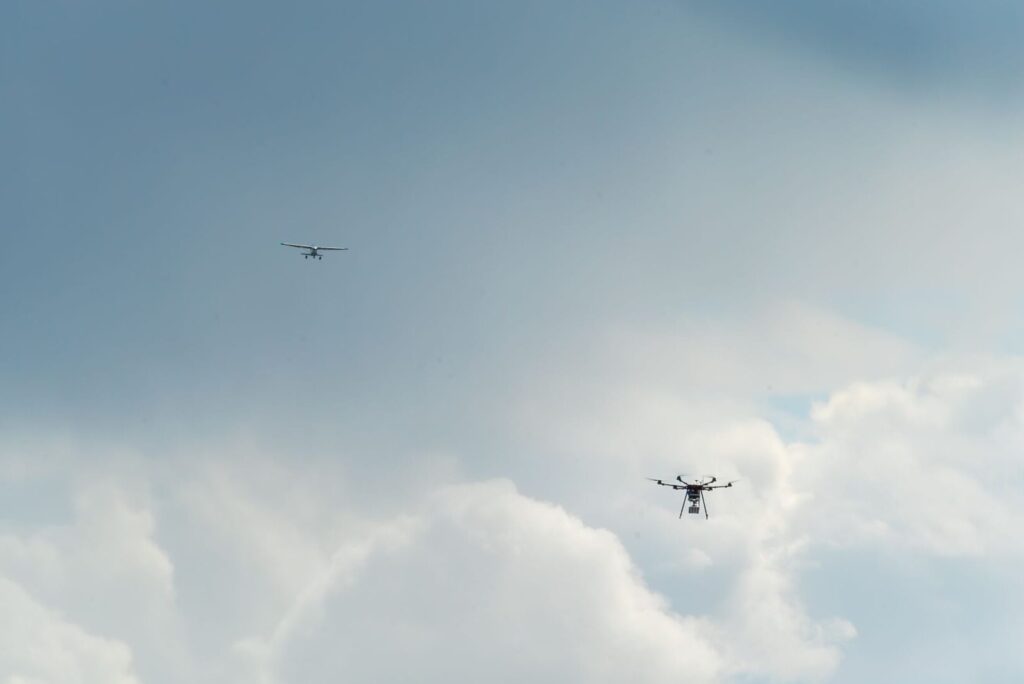
Vigilant Aerospace Systems and the Unmanned Systems Research Institute (USRI) at Oklahoma State University (OSU) have been awarded a state research and development grant to support the integration of radar into Vigilant Aerospace’s detect-and-avoid and airspace management system, FlightHorizon.
The award was made through the Oklahoma Applied Research Support (OARS) program, administered by the Oklahoma Center for the Advancement of Science & Technology (OCAST). The grant supports applied research focused on advancing technologies with commercial potential and relevance to Oklahoma’s aerospace and technology sectors.
Advancing Radar-Based Detect-and-Avoid Integration
The project focuses on integrating radar sensing into the FlightHorizon system to enhance aircraft detection performance in shared airspace environments. FlightHorizon provides “detect-and-avoid” (DAA) and airspace management functions designed to support uncrewed aircraft operations alongside crewed aviation.
FlightHorizon delivers real-time traffic awareness, active alerts, and avoidance guidance to UAS operators. The system supports both cooperative and non-cooperative aircraft detection and is designed to scale across different operational environments. The software architecture is based on an exclusively licensed National Aeronautics and Space Administration (NASA) patent and is intended to support future regulatory and operational requirements for beyond visual line of sight (BVLOS) operations.
Effective DAA capability is widely recognized as a foundational requirement for the routine integration of uncrewed aircraft into the National Airspace. Radar integration is a key component of this effort, particularly for detecting non-cooperative aircraft that are not equipped with transponders.
State-Supported Applied Research
The OARS program supports collaborative research between industry and academic institutions, with an emphasis on transitioning technical innovation toward commercialization. Through this award, Vigilant Aerospace and OSU will work jointly to advance radar-enabled safety capabilities applicable to real-world UAS operations.
OCAST Director Michael Carolina emphasized the role of these programs in supporting collaborative research across the state.
“Each of our programs was created with a goal of supporting science and technology research and development through collaboration between state government, universities, start-up companies, and established firms,” Carolina said. “These projects reflect the strength of research taking place across Oklahoma and its relevance in global technology markets.”
OCAST announced the 2019 awards in its Summer Funding Newsletter, which highlighted 29 approved projects across multiple technology sectors.
Ongoing Collaboration with Oklahoma State University
The grant builds on Vigilant Aerospace’s ongoing development and testing collaboration with the Unmanned Systems Research Institute, which operates within the OSU School of Mechanical and Aerospace Engineering. The partnership focuses on applied research related to uncrewed aircraft safety, sensing, and systems integration. Vigilant Aerospace CEO Kraettli L. Epperson said in part,
“This collaborative partnership with Oklahoma State University is a great opportunity for us to work with some of the leading minds in Oklahoma who are focused on building and testing innovative systems for unmanned aircraft and on pushing the unmanned aircraft industry forward. We are working towards the full integration of unmanned aircraft into the national airspace and are excited that OSU will be joining us in realizing the full potential of our FlightHorizon system with radar.”
OSU also announced the award as part of its broader 2019 OCAST funding recognition, highlighting research initiatives across engineering and applied sciences.
Recent media coverage of the project includes commentary from USRI Director and OSU professor Dr. Jamey Jacob, who discussed the role of applied research partnerships in advancing uncrewed systems technology.
About the Unmanned Systems Research Institute (USRI) at Oklahoma State University
The Unmanned Systems Research Institute (USRI) at Oklahoma State University coordinates research, testing, and development activities related to uncrewed and autonomous systems. USRI brings together expertise from across the university to support applied research in sensing, autonomy, aerodynamics, and system integration, with a focus on transitioning academic research into operational and commercial applications.
About the Oklahoma State University School of Mechanical and Aerospace Engineering
The Oklahoma State University School of Mechanical and Aerospace Engineering conducts education and research in mechanical, aerospace, and related engineering disciplines. The school supports undergraduate and graduate programs while contributing to research in areas including aerodynamics, propulsion, structures, controls, and uncrewed systems, with an emphasis on industry collaboration and applied engineering outcomes.
About the Oklahoma Center for the Advancement of Science & Technology (OCAST)
The Oklahoma Center for the Advancement of Science & Technology (OCAST) is a state agency established to support the development, transfer, and commercialization of technology in Oklahoma. OCAST funds research and development projects that advance innovation, strengthen industry competitiveness, and support economic diversification, while also promoting workforce development and STEM education initiatives across the state.

About Oklahoma Applied Research Support (OARS)
The Oklahoma Applied Research Support (OARS) program is an OCAST funding initiative focused on advancing research and development projects with commercial potential. The program supports collaborations among Oklahoma-based universities, research institutions, and private companies to accelerate technology development and facilitate the transition of new innovations into the marketplace.
 Vigilant Aerospace is the leading developer of multi-sensor detect-and-avoid and airspace management software for uncrewed aircraft systems (UAS or drones). The company’s product, FlightHorizon, is based on two NASA patents and uses data from multiple sources to display a real-time picture of the air traffic around a UAS and to provide automatic avoidance maneuvers to prevent collisions. The software is designed to meet industry technical standards, to provide automatic safety and to allow UAS to safely fly beyond the sight of the pilot. The software has won multiple industry awards and the company has had contracts and users at NASA, the FAA, the U.S. Department of Defense and with a variety of drone development programs. Visit our website at www.VigilantAerospace.com