
Vigilant Aerospace Systems presented at a Federal Aviation Administration (FAA) New and Emerging Aviation Technology (NEAT) series event on June 28, 2023. The invitation reflects the FAA’s focus on integrated safety technologies that support beyond visual line of sight (BVLOS) uncrewed aircraft system (UAS) operations within the National Airspace System.
At the event, Vigilant Aerospace CEO Kraettli Epperson delivered a presentation titled “Integrated Multi-Sensor Automatic Detect and Avoid for BVLOS UAS Based on NASA Patents.” The talk addressed current challenges in BVLOS operations and outlined how integrated, multi-sensor “detect-and-avoid” (DAA) architectures can support scalable and standards-aligned UAS operations.
During the presentation, Epperson emphasized the importance of aligning safety architecture with mission goals and airspace context.
“Vigilant Aerospace takes a very holistic view and understands that one really has to be able to support all of these different levels of safety. The company starts out with determining what one’s goals are, determining where one is going to fly, and what one is going to fly. Vigilant Aerospace identifies the risks; so this is very important.”
Integrated Multi-Sensor DAA for BVLOS Operations
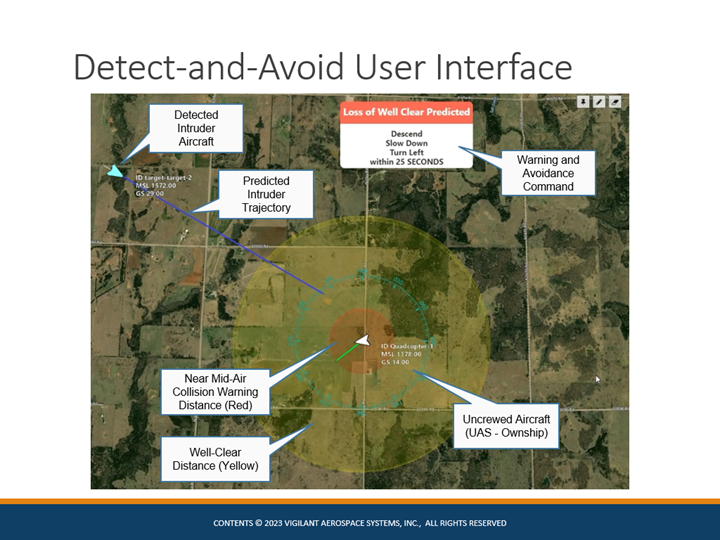
The presentation focused on Vigilant Aerospace’s approach to fully integrated DAA systems for both onboard and ground-based use. These systems combine data from cooperative and non-cooperative surveillance sources to provide real-time situational awareness and conflict detection.
Epperson discussed how multi-sensor fusion supports aircraft detection, tracking, alerting, and avoidance across a range of operational environments. The architecture is designed to function with local sensors, networked data sources, and FAA-provided information. This approach supports continued operation in both connected and degraded environments.
The discussion also highlighted ongoing research areas, including improved sensor integration, enhanced data fusion methods, and software refinements to support evolving regulatory requirements. These efforts are aligned with emerging FAA performance-based frameworks for BVLOS operations.
FlightHorizon Detect-and-Avoid and Airspace Awareness
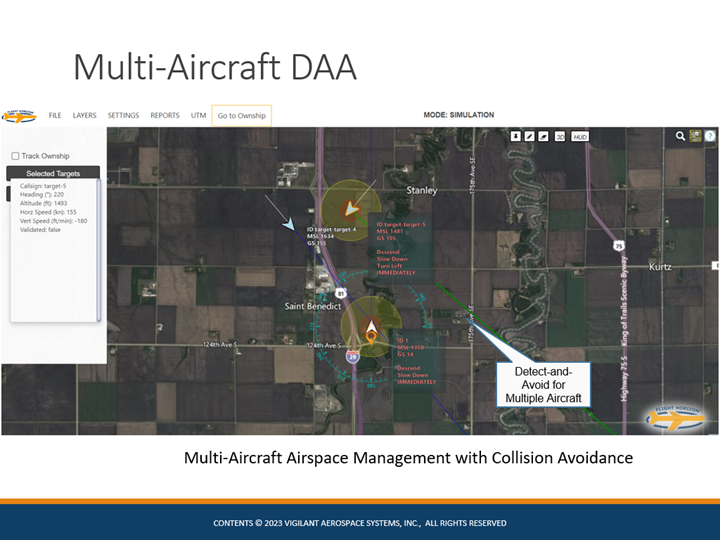
Epperson highlighted Vigilant Aerospace’s FlightHorizon platform as a practical implementation of this integrated DAA approach. FlightHorizon is based on two licensed NASA patents and is designed for flexible deployment across onboard, ground-based, and cloud-hosted environments.
FlightHorizon supports automatic detect, track, warn, and avoid functions for UAS. It integrates inputs from transponder receivers, radar systems, autopilots, weather data, and FAA aeronautical data services. The system provides both visual and auditory alerts to support pilot and operator decision-making.
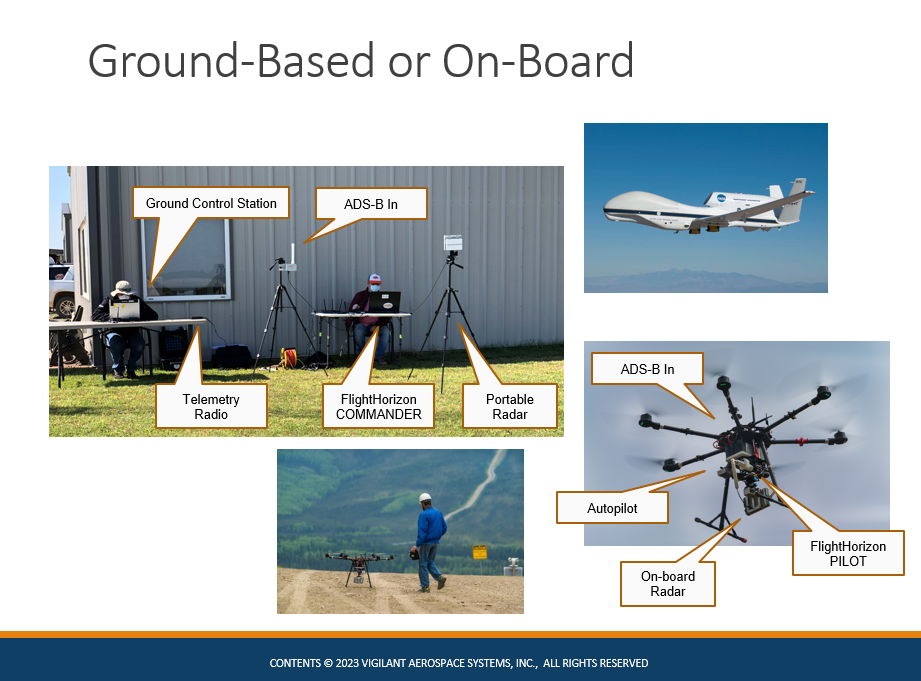
Two primary configurations were discussed. FlightHorizon PILOT is designed for onboard DAA operations and integrates with onboard sensors and avionics. FlightHorizon COMMANDER functions as a ground-based airspace management and unmanned traffic management (UTM) system for facilities, corridors, and regions.
Application Across Civil, Research, and Defense Programs
Vigilant Aerospace has deployed FlightHorizon across a range of civil, research, and defense programs. These include support for UAS test sites, long-endurance aircraft research, medical delivery operations, and military training environments.
Epperson also referenced the importance of standards alignment and regulatory engagement. He was recently selected to serve on the FAA Aviation Rulemaking Committee (ARC) focused on BVLOS rule development for small UAS. That committee is tasked with informing future FAA regulations governing routine BVLOS operations.

FAA NEAT and the Role of Emerging Technologies
The FAA NEAT program serves as a forum for evaluating technologies that may shape the future of aviation. The event brings together regulators, researchers, and industry participants to examine concepts that impact safety, integration, and operational scalability.
The discussion at NEAT underscored the growing need for integrated DAA systems as BVLOS operations expand. Multi-sensor architectures and data-driven safety systems are increasingly viewed as core infrastructure for advanced UAS operations.
Full Presentation
About the FAA New and Emerging Aviation Technology (NEAT) Initiative
The FAA New and Emerging Aviation Technology (NEAT) series evaluates advanced aviation concepts and technologies that may affect the future of the National Airspace System. NEAT series events provide a venue for industry, government, and research organizations to share technical approaches and inform regulatory and policy development.
 Vigilant Aerospace is the leading developer of multi-sensor detect-and-avoid and airspace management software for uncrewed aircraft systems (UAS or drones). The company’s product, FlightHorizon, is based on two NASA patents and uses data from multiple sources to display a real-time picture of the air traffic around a UAS and to provide automatic avoidance maneuvers to prevent collisions. The software is designed to meet industry technical standards, to provide automatic safety and to allow UAS to safely fly beyond the sight of the pilot. The software has won multiple industry awards and the company has had contracts and users at NASA, the FAA, the U.S. Department of Defense and with a variety of drone development programs. Visit our website at www.VigilantAerospace.com