
Vigilant Aerospace Systems has formally launched a radar testing program at the Alaska UAS Test Site. The program is conducted in partnership with the University of Alaska Fairbanks (UAF) and the Alaska Center for Unmanned Aircraft Systems Integration (ACUASI). The work is funded under a Federal Aviation Administration (FAA) research and development contract awarded through a Broad Agency Announcement (BAA) solicitation.
The testing program focuses on advancing “detect-and-avoid” (DAA) capabilities for unmanned aircraft systems (UAS). The effort aligns with FAA research objectives for beyond visual line of sight (BVLOS) operations. It also supports airspace integration and scalable safety architectures for civil and commercial UAS missions.
Vigilant Aerospace CEO Kraettli L. Epperson said in part,
“We are delighted to have the support of the FAA through the BAA contract and to have the great coordination and expertise of the Alaska UAS Test Site, University of Alaska Fairbanks, and ACUASI R&D engineering and flight teams to conduct these tests.”
Radar-Based Detect-and-Avoid Flight Testing
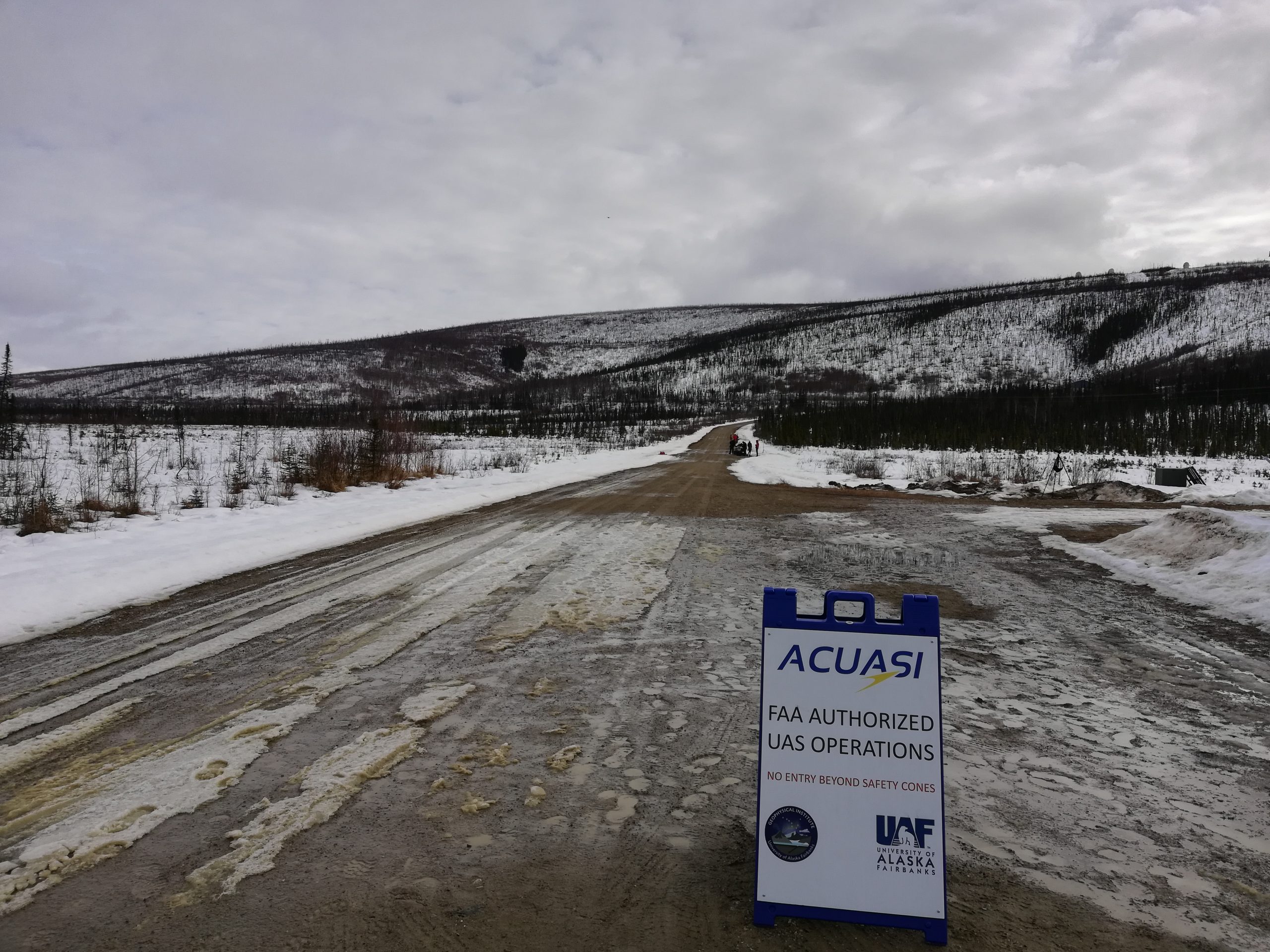
The flight test campaign evaluates multiple radar systems detecting manned aircraft operating at low altitudes. Test scenarios include both fixed-wing aircraft and helicopters. Ground-based and airborne radar sensors are integrated with Vigilant Aerospace’s FlightHorizon detect-and-avoid and airspace management software.
Flight testing is conducted at the FAA-designated Alaska UAS Test Site in coordination with ACUASI and UAF flight operations teams. The tests were initially announced as part of the FAA’s UAS BAA research program and are structured to generate data relevant to FAA safety cases and standards development. Vigilant Aerospace Director of Business Development Zach Peterson said,
“This research and development can go a long way towards setting safety cases for conducting civil and commercial UAS operations like search and rescue, agricultural surveying, aerial infrastructure inspections of power lines and roadways, and especially the delivery of critical goods to rural communities in Alaska and other states where infrastructure and delivery timing can be uncertain, expensive and difficult.”
Multi-Sensor Integration and Data Fusion
A central objective of the program is to evaluate how commercially available radar systems can be combined with non-radar sensors. The goal is to create an economically viable detect-and-avoid solution. Selected sensors reflect advances in compact digital radar technology. These systems are suitable for small and medium UAS, including Group One and Group Two aircraft.
Testing evaluates how multiple sensors can be fused within the FlightHorizon software environment. This fusion provides a comprehensive airspace picture at both short and long ranges. The goal is to support timely detect-and-avoid alerts. Future configurations may enable autonomous conflict resolution through autopilot integration.
Supporting Advanced UAS Operations and Safety Cases
Flight testing was scheduled to begin in early 2021 and continue over several months. Planned operations include flights in rural Alaska as well as areas in and around Fairbanks. These scenarios support evaluation of detect-and-avoid performance for long-range and emerging advanced air mobility-style operations.
Data generated through the program is intended to be provided to the FAA and used to inform continued development of FlightHorizon and related detect-and-avoid capabilities. Epperson said,
“We look forward to being able to provide this data to the FAA and to inform our own system and software development using these tests. We expect to have significant data from multiple new sensors to advance our system and integrate new radar and other sensors into future detect-and-avoid configurations.”
About the Alaska UAS Test Site
The Alaska UAS Test Site, also known as the Pan-Pacific UAS Test Range Complex (PPUTRC), is one of six FAA-designated UAS test sites in the United States. Managed by the University of Alaska Fairbanks, the test site spans multiple climate zones and supports UAS testing in Arctic, tropical, and arid environments. The site builds on the research and operational capabilities of the Geophysical Institute’s Alaska Center for Unmanned Aircraft Systems Integration (ACUASI).
About ACUASI

The Alaska Center for Unmanned Aircraft Systems Integration (ACUASI) is a research center within the University of Alaska Fairbanks focused on integrating unmanned aircraft into civil, scientific, and government missions. ACUASI supports UAS operations across a wide range of aircraft classes and payloads, with particular expertise in Arctic and sub-Arctic environments. Its capabilities include flight operations, payload integration, engineering support, and secure data management for complex UAS missions.
 Vigilant Aerospace is the leading developer of multi-sensor detect-and-avoid and airspace management software for uncrewed aircraft systems (UAS or drones). The company’s product, FlightHorizon, is based on two NASA patents and uses data from multiple sources to display a real-time picture of the air traffic around a UAS and to provide automatic avoidance maneuvers to prevent collisions. The software is designed to meet industry technical standards, to provide automatic safety and to allow UAS to safely fly beyond the sight of the pilot. The software has won multiple industry awards and the company has had contracts and users at NASA, the FAA, the U.S. Department of Defense and with a variety of drone development programs. Visit our website at www.VigilantAerospace.com