
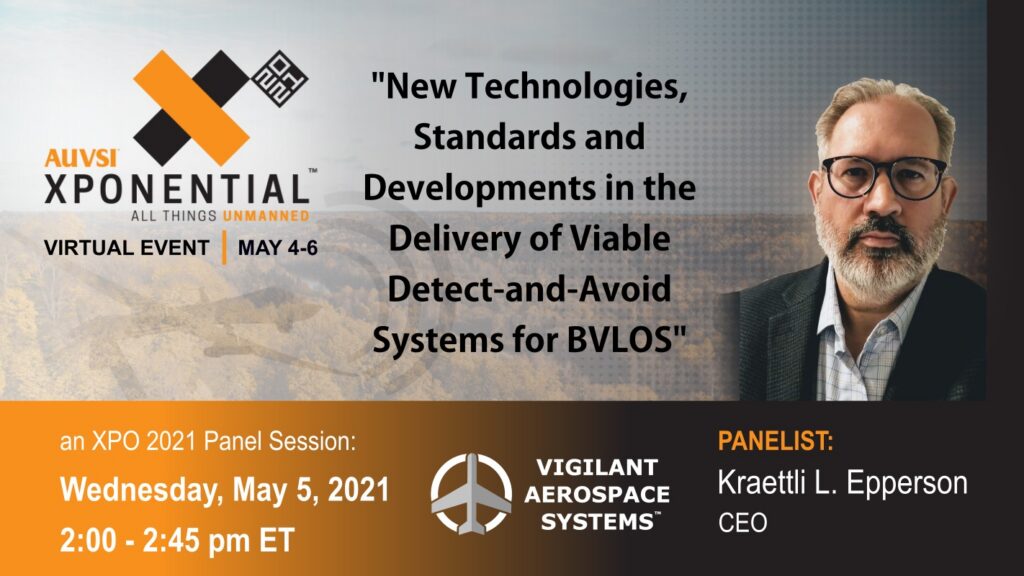
At AUVSI XPONENTIAL 2021, Vigilant Aerospace Systems CEO Kraettli L. Epperson participated in a virtual panel titled “New Technologies, Standards and Developments in the Delivery of Viable Detect-and-Avoid Systems for BVLOS Commercial UAS.” The session focused on what it will take to deliver operationally credible “detect-and-avoid” (DAA) capabilities for routine beyond visual line of sight (BVLOS) uncrewed aircraft system (UAS) operations, with emphasis on multi-sensor integration, standards, and validation pathways.
In the opening section of the discussion, Epperson outlined Vigilant Aerospace’s approach to DAA through the FlightHorizon product line, and the integration work required to move from component technologies to testable systems. He described how FlightHorizon correlates multiple surveillance inputs, predicts potential conflicts, and produces alerts and avoidance guidance that can support either ground-based operations or onboard autonomy concepts.
Panelists
The panel included three speakers representing DAA software and integration, radar technology, and UAS test site operations:
- Kraettli L. Epperson, CEO, Vigilant Aerospace Systems. He presented Vigilant Aerospace’s DAA architecture and integration approach using the FlightHorizon platform.
- Mo Hartney, Director of Applications Engineering at Echodyne. Hartney also serves in public policy and project management roles and has a U.S. Air Force background supporting the A-10C, plus experience as an instructor and liaison at the National Geospatial-Intelligence Agency.
- Dr. Catherine F. Cahill, Director of the Alaska Center for Unmanned Aircraft Systems Integration (ACUASI) at the University of Alaska Fairbanks (UAF), and CEO of the Pan-Pacific UAS Test Range Complex, an FAA UAS Test Site. Cahill’s background includes degrees in applied physics and atmospheric sciences, and long-term work on UAS-based atmospheric sensing.
Detect-and-Avoid as a Practical Requirement for Routine BVLOS
A core theme of the panel was that routine BVLOS operations require DAA capabilities that can detect and avoid cooperative and non-cooperative aircraft, including aircraft without transponders. The session framed DAA as a safety requirement and a cost driver, because long-range BVLOS concepts become difficult to scale without trustworthy, repeatable onboard or operationally integrated DAA functions.
Epperson emphasized that implementation is not a single sensor problem. It is a systems problem that spans surveillance, data fusion, human factors, and integration with UAS control and operational procedures.
Vigilant Aerospace’s Technical Contribution
Epperson’s portion of the panel highlighted how FlightHorizon is designed to integrate multiple surveillance sources into a single operational picture, then convert that fused track set into actionable conflict detection and avoidance outputs. Inputs discussed included transponder data, radar, UAS flight controller data, and online data sources, tied together through multi-sensor correlation.
He also described how Vigilant Aerospace positions DAA across different deployment models, including systems supporting UAS pilots or airspace managers (FlightHorizon ALERT), and architectures that can be hosted, installed on-site, or ground-based (FlightHorizon TEMPO), or onboard depending on the operational need (FlightHorizon PILOT-C & PILOT-M).
Within the FlightHorizon suite, the presentation distinguished between airspace management use cases and onboard DAA integration, including configurations that incorporate radar and cooperative surveillance such as ADS-B In, alongside other sources.
Standards, Algorithms, and Validation Pathways
A second technical focus was standards alignment and the supporting “means of compliance” work needed to make DAA credible for regulators and customers. The presentation referenced major standards bodies and documents shaping DAA requirements and test methods, including ASTM and RTCA materials focused on DAA performance, software dependability, and radar surveillance interoperability.
The abstract materials also pointed to related integration topics, including how DAA supports Unmanned Traffic Management (UTM), and how air surveillance radars may contribute data as a Supplemental Data Service Provider (SDSP). It also noted the importance of test results, simulation, and encounter data in demonstrating safety cases suitable for regulatory review.
Development Trends and What “DAA Success” Looks Like
The panel’s framework for progress focused on engineering trends that reduce barriers to deployment. Those include low size, weight, and power (SWaP) onboard components, maturing test and certification pathways, and more robust system assurance approaches.
Epperson closed with a definition of DAA success that is operational rather than theoretical: layered and continuous safety, integration across onboard and ground-based resources, modular standards-based architectures, and reduced compliance cost that enables operational tempo and scalable business models.
Read the full presentation and transcript below.
Full Presentation
Full Transcript
Kraettli: I’m Kraettli Epperson CEO, Vigilant Aerospace, and I’m delighted to be here today moderating our industry panel on detect an avoid systems for beyond visual line site commercial UAS. For AUVSI XPONENTIAL 2021. I’m very grateful to be leading this panel on technologies around detect-and-avoid.
I am joined and I’m very grateful for the participation of my two co-panelists here, they are:
Mo Hartney, the Director of Applications Engineering at Echodyne Corporation. Echodyne is producing revolutionary portable radars, and we’re really excited to hear lot more about what they’re doing, which we’ll do during this panel. Mo is the Director of Applications Engineering there. I have seen her working in the field and have had an opportunity to work with Echodyne, and so we’re excited to have them today.
We also have Dr. Cathy Cahill. We’re delighted that she could join us. She is Director of ACUASI, The Alaska Center for Unmanned Aircraft Systems Integration at University Alaska Fairbanks. She’s also the CEO of the Pan-Pacific UAS Test Range Complex, which is one of the six recognized FAA UAS Test Sites. Cathy leads one of the top UAS research centers in the world, and so we are absolutely delighted to her here. She has lots of interesting projects going on and I’m sure she’ll be able to tell us about a lot of that during our panel today.
So I’m going to ask our panelists… I’m going to queue this panel up, we have forty-five minutes…
We’re going to talk very briefly about what the problem is and why detect-and-avoid is so very important to the industry, and then I’m going to ask each panelist to make a brief presentation to provide some background about their experience and their organizations and some of the projects and technologies that they’re working on.
I’ll start that off with a presentation about Vigilant Aerospace. And then after that, we will have time for Q&A. There are a variety of important themes and topics that we can hit on today, many of which will probably prompt questions from our presentations. Some things that we have queued up to talk about would be the different components of a DAA system, some of the emerging standards and technologies, and then emerging development that is pushing the industry and pushing detect-and-avoid forward.
That will start us off and then we’ll try to leave plenty of time for Q&A. So, talking a little bit about this problem…
I didn’t introduce myself really… I’m Kraettli Epperson, CEO of Vigilant Aerospace, and we develop software based on a couple of NASA patents for integrating and building full detect-and-avoid systems with software and a variety of sensors and data coming into that and I’ll talk more about that in the moment.
I think everyone who’s listening to this probably knows why detect-and-avoid systems are so critical to the industry right now. Beyond visual line-of-sight flight of unmanned aircraft requires the ability to detect-and-avoid other aircraft. This is absolutely critical. The systems must be able to see and detect-and-avoid manned aircraft, especially those without transponders – so, what we would call non-cooperative air traffic – is especially critical, and one of the reasons that this can be a complex problem that requires a lot of data.
These systems, because they are safety critical must be trustworthy, and they must be well tested. That means different things in different contexts that, but it’s emerging as a very important part of this process.
We also know that, as the industry develops, onboard detect-and-avoid is going to be very important to make long-range beyond visual line-of-sight flight of unmanned aircraft practical and economical. So that the manned aircraft can operate wherever it needs to go. Obviously, our corridor is being developed. I think looking forward to the ability to…
… are an important part of an autonomy strategy, they can be complex and expensive because of some of the technologies involved, which is why the partnerships that we’re going talk about a little bit during this panel are very important to the development of this technology.
The final thing I’ll say an introduction here is that relevant technologies and regulations and everything that goes with detect-and-avoid systems are emerging right now. That’s why this panel is really exciting at this point in the history of the industry.
So a little bit about our background. I’m just going to do a couple of slides here about Vigilant Aerospace.
We produce a family of products called FlightHorizon. This is a diagram about how this works. This is safety software. We do systems integration hardware into that software. It’s either for individual UAS pilots, for airspace managers, provide situation awareness, display of traffic, and it provides active avoidance, so it’s really the avoidance part of detecting.
It’s based on NASA patents that we have licensed out of NASA Armstrong and it does multi-sensor correlation. That’s an important function. It predicts conflicts, issues warnings and provides specific avoidance commands either to the pilot or to the autopilot.
There’s a picture to give you a real quick idea of what the software is doing, whether it’s displaying it or providing it to the autopilot.
In the center here, you’ve got this white aircraft, which is your own aircraft. You have a yellow ring around it, which is your mandated well-clear distance from other air traffic, and the system is constantly watching that. It is constantly predicting where other detected air traffic might be going, and then it will decide if there is a potential conflict to provide you with a warning and then with an efficient avoidance maneuver to avoid that conflict.
You can see here, it’s detected a potential conflict and it’s providing an avoid mover, which is the green line, plus it is talking to you and it’s displaying information avoidance.
We have three products:
One is FlightHorizon COMMANDER, which is our ground-based system for drone ports, airparks, or any place where you might have a larger radar, and you might have access to online data.
FlightHorizon PRO, which is our portable product for use with portable radars and other portable receivers.
And then, we’re really excited to talk about FlightHorizon PILOT, which is our on-board system, which uses radar, ADS-B In and connection to the autopilot to provide these services on board to be supervised from the ground.
Very briefly, some of the projects that we have worked on. I won’t go through all of these, but I’ll just say we have worked closely with NASA, in particularly NASA Armstrong. Our products have been used both in unmanned and manned aircraft, especially the [NASA] supersonic program uses our system.
We have been a part of the [FAA] IPP program with both ACUASI and with the Northern Plains UAS Test Site in North Dakota. That is very productive for us.
And we have also been a partner with the Unmanned Systems Research Institute at OSU, where we have recently completed a radar integration and testing project.
Our new and upcoming projects, which are the ones that we’re really excited about right now. We’re in the middle of our FAA R&D contract in which we are testing a variety of sensors and systems to develop detect-and-avoid systems. That’s been a great project in which we have partnered with ACUASI. We are in the middle of that right now.
We also have a plan to roll out our COMMANDER system at Northern Plains UAS Test Site. We’ve recently joined the ACUASI BEYOND program, and we’re looking for just and testing and projects there. We’re part of the NASA ULI WINDMAP project, which is a project bringing in wind-hazard data into avoidance systems like ours. And, then we have ongoing work with NASA.
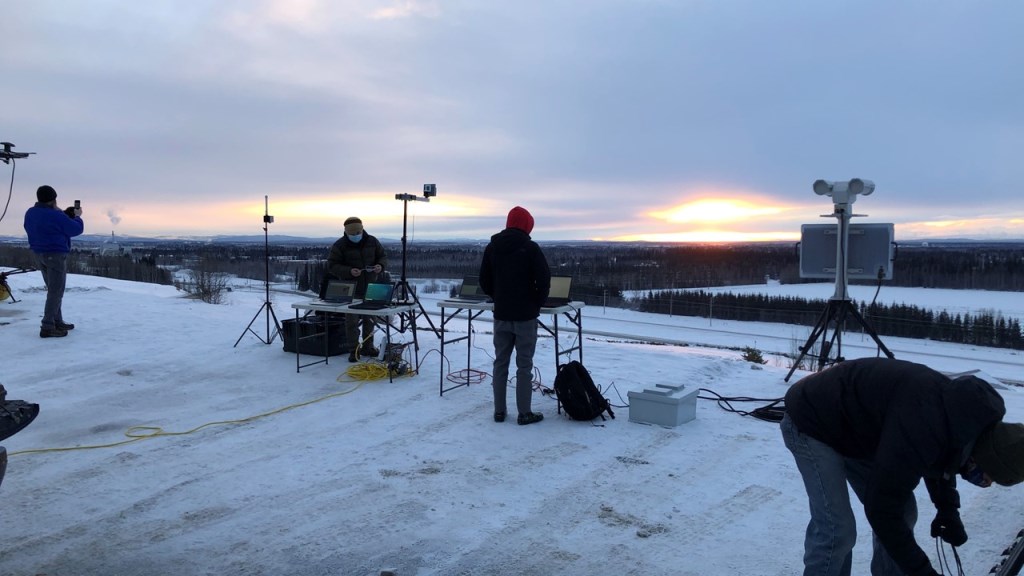
So, that’s a little bit of background about us. I’ve got a couple of photos here. tTis is one of the team working near Fairbanks with the ACUASI team to do some testing over a variety of systems.
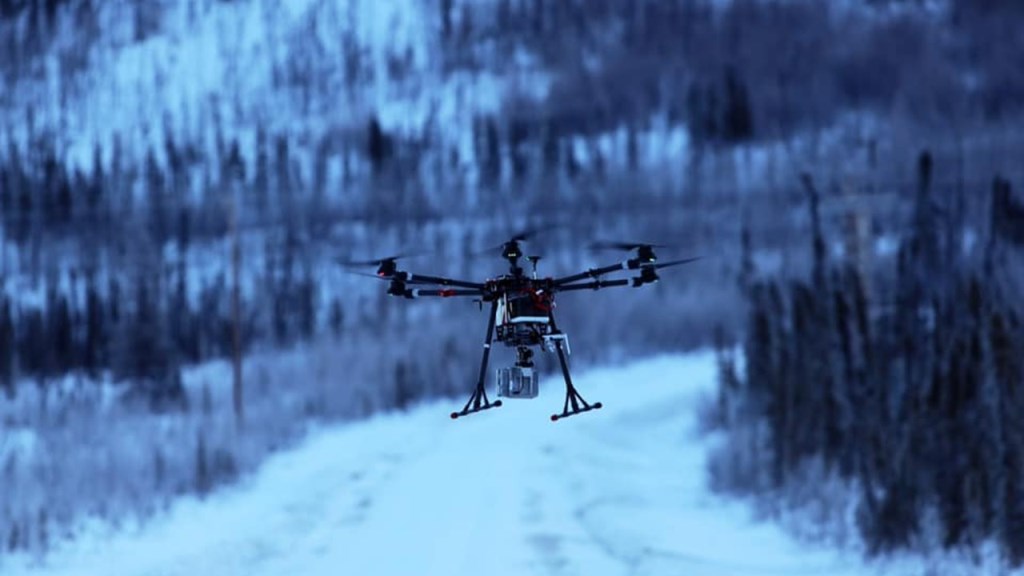
They’re going to be doing this again in a couple of weeks. And this is an image of an Echodyne radar onboard an ACUASI UAF drone with our software monitoring and providing detect-and-avoid services. This is kind of a nice mix of all of these systems and partners.
Kraettli: Cathy, thank you so much. And that was a lot of great information. So I would love to have this opportunity to answer some questions, now we’ve begun to receive a few questions and we’ll make it a priority to answer those, we have a few more slides on general topics that we can run through. Particularly, if they’re useful for answering questions.
I’ll answer one question really quickly that was directed towards me. Someone mentioned that we have a Pixhawk in some of our schematics. This is a flight controller or autopilot that is very popular, it’s based on some open-source standards, it speaks a language called Math link, and it’s really awesome. We do communicate with that out of the box, our system is highly modular, and we have a lot of other auto pilots that we’re targeting for integration. So happy to talk with anyone about that. If you have questions about integration, we can absolutely do that, and our software is highly modular, there’s another question here that I will offer a very brief opinion on, and then I will very much ask me and Cathy to address this… Well, actually the second question is for me, and then I’ll jump to a third question, second question is, can you make a reader that it has a frequency that can be licensed outside the US, particularly for UK and EU spectrum management, and especially for carbon radars.
0:34:57.1 S2: So now that’s a question that maybe you can answer… Yeah.
0:35:00.1 S1: Of course, I’d be happy to. First of all, I love the double smiley faces that came through for this question, I hope those were from the actual question asked her, and I recommend that if you ever email me, add those double smiley faces in there, it makes a lot of my emails a lot more positive in terms of spectrum, I spoke a little bit about it on the slide after we got the question. Currently, the spectrum man that we’re in now is 2445 to 2465 gigahertz in Europe, that’s problematic because that spectrum band is being allocated for 5G, so for the ground-based radar, we have an international version that’s essentially the same radar, but the tuned to 2405 to 2425 giro we’ve moved the spectrum band down a little bit in terms of the frequency spectrum, we don’t yet have an Echo flight in that spectrum band, and then I would say if you’re thinking about an entirely other spectrum band, so a more applicable band for not just the US but Europe and maybe Asia as well, what does that look like? That’s a whole new radar design because the frequency directly impacts what the antenna looks like, so in that case, we would need to make a business case on, do we make a new radar, what does that radar look like in terms of requirements, but near term, is that 2405 to 25 band works for you.
0:36:31.0 S1: You can always let me know and we can kind of move towards putting a requirement in place to making the Echo flight operable at that spectrum as well.
Kraettli: Thanks, MO, that was great. We have another question. Our third question here:
Q3: In terms of airborne radar, what are thoughts about the need for a full 360-degree surveillance volume and will that meet the risk ratio or is the meeting the risk ratio adequate as an alternative to having 360-degree surveillance?
Kraettli: And that’s a very interesting question. I’ll just provide a little bit of what I think about that. And then also, and Cathy, you weigh in on that, that risk ratio is very important, that is, for example, the way that the ASTM detect-and-avoid standard and other emerging standards and waivers, talk about using a detect-and-avoid system is to achieve a certain level of risk mitigation, and as long as you’re achieving that, then the actual system and exactly what I do does and where it’s looking… Win is not required, right? So if you’re meeting the risk ratio, then you’re meeting the standard, for example, and then that may become a means of compliance for meeting a rule, etcetera. So I think the answer probably is that in some cases, there will be safety cases, there will be air risk ratios and ground risk ratios, and classes in which you will be able to use a radar that is pointed in a particular direction in one linear infrastructure inspection for example, you might be able to do this because you have specific risks that you are countering it and mitigating, and so if you can look at the existing waivers, you can look at the direction of the technology and the concepts of operation safety cases that are being successful, and I think you will find cases where that’s the case, and certainly other ones where it’s not, where you absolutely have to have 360-degree coverage in order to make that safety case and meet your risk ratio based on traffic patterns and risks in that area.
0:38:43.3 S2: So that’s kind of just a brief… I think it depends, but I think there will be cases where you can do that… No, Cathy, you all probably have ideas about that as well… Yeah.
Mo: I speak really briefly to this and then pass it to Cathy, if that’s okay. So I think from my perspective, Kraettli and Cathy will have more experience than I will on building that risk ratio safety case, I’ve seen one successful instance of that with a partner, but again, it was a ground-based Radar versus an airborne radar. So they can speak more eloquently to what the VA considers compelling in the airborne da risk ratio world. However, from a sensor perspective, requiring 360-degree coverage in all instances of airborne detected requires for us three of our radars to go around the aircraft, so each RAD is 120 degrees in asthma, so you need at least three NRS to cover 360, what that means for… Then the folks flying the UAV is now you’ve got to three or ours to your UAV, and that’s quite a few quite lagoons, more power reduces your flight time significantly, so we’re proponents of maintaining that phase 1 MOPS from RCA 228 of 220 degrees asthma field of view. For the majority, if you’re looking at how do I tie it to an existing standard… Well, there is a standard in place for 220 and for us, that’s two radars in a chevron configuration, so that’s just from a sensor perspective of if you’re requiring a lot more of the sensor and a lot more instances of the sensor, then now you’ve got a really heavy, kind of slow and under-performing vehicle at that point, so all up on what Moe said, the 220 for us is a good way to go forward in terms of having a standard to plot.
0:40:49.5 S1: The challenge is, of course, with the whole concept of if you’re being overtaken, and the fact that the mandar craft must always get out of the way, so you need to have that situational awareness of what’s going on around you to be able to move. And for us, dealing with general aviation who may or may not actually be operating ads under 10000 feet, the fact that we have to get the way when they’re not paying attention and don’t know what we’re doing, means that the 360 can be a very, very valuable thing for us, but it is a case where it does significantly and weight, and we all know that swap is worth so much. So this would work really well on things like our C-Hunter, which are much lower craft, it’s not going to work well on some of the smaller aircraft that we might use for long linear infrastructure monitoring, so it really is going to be a case of trying to put… The correct radars on for the different missions, if you happen to be using other mitigation strategies such as infrastructure masking, where you happen to be flying very close to something, you can potentially get away with a lot less in terms of those detect-and-avoid technologies.
0:42:10.0 S1: So it is a case where, from what I’ve seen, I think it’s going to have to be a either 360 220 or a multi-layered approach to DAA working home. And I would expect it probably by the time we’re all done with this, we will be looking at very layered approaches with equipment approaches and also with operational, strategic and taxable. So it’s going to be a challenge to hit that sweet spot, but we are making progress and we are flying cadet radar, so this is something where we are testing what effectiveness is on some smaller systems to see what we can get away with because of course, every pound of radar, we put on it Ponte payload we can’t carry in terms of cameras and other things…
0:43:04.6 S2: We just have a couple of minutes left. No, could you jump to our last slide and then we might try and take one more question and then I’m going to just just sum up for us just a tiny bit maybe in the last 30 seconds here, so we got a couple of interesting questions about the vertical field of view of radar and how critical it is to be able to see 360 plus the ability to see in a larger vertical field of view, particularly for larger UAS mode. Do you have a quick response about how you all think about vertical field of you… Yeah.
0:43:42.3 S1: The vertical field of… You would be fast. So for the eco-flight is from the middle point of the radar plus or minus 40 degrees, so it’s an 80 degree elevation field of view, and the mom’s… Pop was for me on… Do I remember the mops? I believe it’s in a 30 degree total elevation field of you, so we outperform the box in terms of the current Acholi…
0:44:03.6 S2: Excellent. Hey, go back actually one or two slides to the one where I have listed… Here we go. Yeah, so part of what my was talking about is down here in the sc228, there are multiple minimum operating performance standards that have been released by the RCA, there’s maps on which mode you reference, which I think is extremely useful for people to be aware of, and they’re working on a UPS too, and there are some other interesting things going on there, and then there are the ASTM standards for small UAS, so I just references real quickly, ’cause we’ve talked about those a couple of times, I think I’m going to jump now ’cause we just have a few moments left. How can you go to our last slide, this is just a little bit of a summary here about how we as a company, for example, think about detect-and-avoid, and why these partnerships and all of this testing with Kathie quasi and with Cody and other partners is so very important, we’re thinking holistically about how we bring detect-and-avoid to the market and to every business case and use case in a way that’s really viable.
0:45:14.6 S2: We really think it has to be continuous. It has to be automatic, it’s always going to be multiple layers, it’s going to be strategic and then tactical, so you’ve gotta be flying safe and have multiple systems in place, that’s really how we think about it, and we think that’s what’s going to be successful… Very interested in integration, obviously with UTM, is that emerges both as an add-on and as an integrated part of UTM, we think it needs to be developed as part of the aircraft from the ground up, so I’ll just… I’ll leave it at that. And I think my panelists very much for joining us, think a VSI, for allowing us to have this panel on this very important topic, I would encourage everyone to reach out to any of us with additional questions or other… Several questions that we couldn’t get to and is a very technical topic, and hopefully you have a great remainder of your conference. And again, thank you all very much.
About AUVSI
The Association for Uncrewed Vehicle Systems International (AUVSI) is a nonprofit membership organization focused on advancing uncrewed systems and robotics across air, ground, and maritime domains through industry engagement, policy work, and professional collaboration.
About ACUASI

The Alaska Center for Unmanned Aircraft Systems Integration (ACUASI) is the University of Alaska Fairbanks UAS program, with a mission that includes UAS research and integration work supporting government and science users, with emphasis on Arctic and sub-Arctic operating environments.
About XPONENTIAL

XPONENTIAL is an annual global conference and exhibition for uncrewed systems and autonomy, bringing together industry, government, and research leaders across aviation, maritime, and ground domains. The event is organized by AUVSI and serves as a forum for policy discussions, technical education, and technology demonstrations related to autonomous systems.
 Vigilant Aerospace is the leading developer of multi-sensor detect-and-avoid and airspace management software for uncrewed aircraft systems (UAS or drones). The company’s product, FlightHorizon, is based on two NASA patents and uses data from multiple sources to display a real-time picture of the air traffic around a UAS and to provide automatic avoidance maneuvers to prevent collisions. The software is designed to meet industry technical standards, to provide automatic safety and to allow UAS to safely fly beyond the sight of the pilot. The software has won multiple industry awards and the company has had contracts and users at NASA, the FAA, the U.S. Department of Defense and with a variety of drone development programs. Visit our website at www.VigilantAerospace.com