
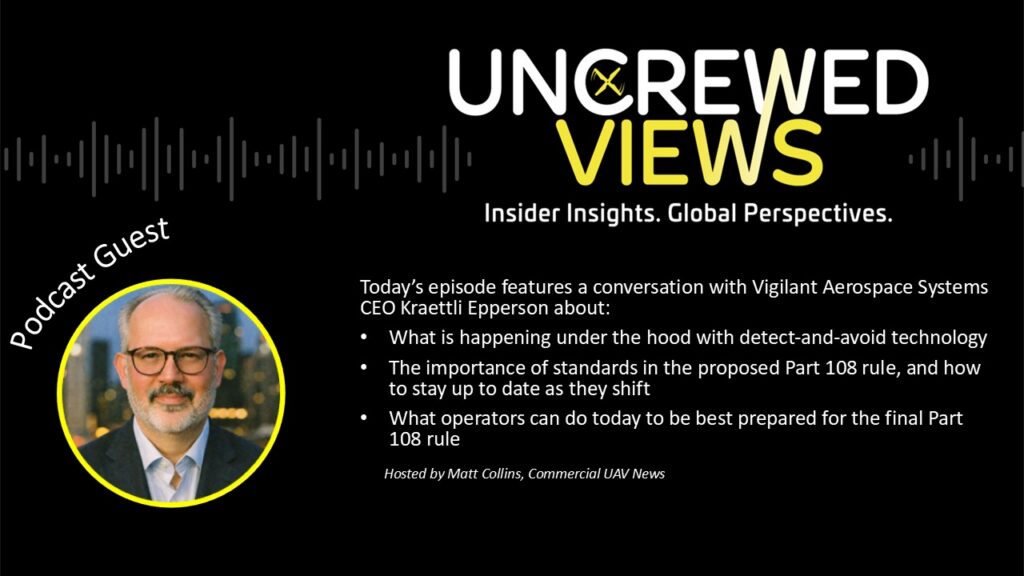
Vigilant Aerospace Systems CEO Kraettli Epperson recently joined Matt Collins on Uncrewed Views, the Commercial UAV News podcast, for a discussion on detect-and-avoid technology, the Federal Aviation Administration’s proposed Part 108 rule, and what operators and manufacturers can do now to prepare for routine beyond visual line of sight (BVLOS) operations. The conversation focused on how the proposed rule could shift BVLOS operations from waiver-based approvals toward a more scalable regulatory framework, while placing significant emphasis on technical standards, safety systems and operational readiness.
Epperson discussed Vigilant Aerospace’s FlightHorizon product family and its role in providing automatic collision avoidance for uncrewed aircraft systems (UAS). He explained how detect-and-avoid (DAA) systems combine aircraft position data, autopilot telemetry, Automatic Dependent Surveillance-Broadcast (ADS-B), Remote ID, radar, cameras and other sensors to identify both cooperative and non-cooperative aircraft. The software then calculates whether a “loss of well clear” may occur and can generate a resolution advisory, including avoidance maneuvers based on Airborne Collision Avoidance System X (ACAS X) algorithms.
A major theme of the interview was the role of consensus technical standards in the proposed Part 108 and Part 146 framework. Epperson described how standards developed through organizations such as ASTM International and RTCA can allow the FAA to reference technical requirements without rewriting regulations each time technology changes. For operators and manufacturers, he said the practical takeaway is to ask vendors which technical standards their aircraft, avionics and DAA components are designed to meet, and how those standards support the intended regulatory pathway.
Discussing the FAA’s proposed Part 108 framework for routine beyond visual line of sight operations, Epperson said the rule could provide the regulatory certainty needed for broader commercial drone deployment:
“The rule creates a lot of certainty. When it is published, suddenly you know what to invest in, what to build, what you can fly, where you can fly it, what markets you can serve, and what missions you can carry out without a lot of additional work or investment and without waivers. That will immediately grow the industry, we think. We think we are on the cusp of a major change and major growth.”
The discussion also addressed how operators can prepare before the final rule is published. Epperson recommended that operators define their use case in detail, including where they intend to fly, aircraft size, payload requirements, altitude, weather exposure, ground risk, network access and whether the operation is likely to require cooperative-only or non-cooperative detection. He noted that lower-risk, low-altitude operations may be able to rely on cooperative aircraft surveillance in some cases, while higher-risk environments, including more populated areas and complex airspace, are likely to require active sensing through radar, cameras or other surveillance infrastructure.
Listen to the full episode here.
Full Transcript
Matt Collins: Welcome to a new episode of Uncrewed Views, a podcast brought to you by Commercial UAV News. My name is Matt Collins. I am the content manager for Commercial UAV News, as well as our in-person event, Commercial UAV Expo.
For this week’s episode, I am joined by Kraettli Epperson. He is the co-founder and CEO of Vigilant Aerospace Systems.
In this week’s conversation, we are again talking about Part 108, with Epperson adding a valuable perspective on a couple of fronts. First, his company works specifically on detect-and-avoid technology, which, as we discuss, and as most people listening to this probably know, is a big part of the proposed rule around Part 108.
He was also involved in both the FAA’s Beyond Visual Line of Sight Aviation Rulemaking Committee, as well as the ASTM F38 committee around standards. As we talk about in the conversation, and again we are going off the Notice of Proposed Rulemaking (NPRM), standards play a big role in this rule. A lot of pieces are not tied to specific regulations, but instead are tied to consensus industry standards, which will allow for more evolution.
We get more into that in the conversation, along with discussions about what detect-and-avoid technology is actually doing under the hood, what potential Part 108 operators might be overlooking right now, and how operators should generally prepare for the ultimate implementation of whatever that final rule ends up looking like.
A couple of notes before you listen to the conversation. First, this was recorded on June 11, so it has been a few weeks since we actually had the conversation. That being said, nothing has really materially changed since the recording. I just wanted to throw that out there.
And again, as I bring up anytime we are talking about Part 108, this is all related to the NPRM. We do not know what the final rule is going to look like yet, or what is going to change from the NPRM.
Before we get into the conversation, I do want to get into a couple of very quick housekeeping notes that I know you have heard before, so I will make it quick. One is the State of the Industry Survey. I have talked about it a bunch on this podcast before, and you have heard it all before. The survey takes about 10 minutes to complete. We are looking for input from people at all levels of the industry. I will drop a link to the survey in the show notes for this episode. Please go take it. If you are listening to this on the day this comes out, July 1, it is only open for a couple more days. We are closing it on July 3. Please get that in if you are able to.
Also, registration is open for Commercial UAV Expo. The show this year is September 1 through 3, back at Caesars Forum in Las Vegas. Head to expouav.com. You can find all the information about the show, the conference program, the exhibitors, and all the things happening on the show floor. You will also see registration buttons all over the page to make sure that you will join us there in Las Vegas.
With all of that out of the way, let’s jump into our conversation with Kraettli Epperson.
INTERVIEW
Matt Collins: Welcome back into Uncrewed Views. I am now joined by our guest for this week’s episode, Kraettli Epperson. He is the CEO of Vigilant Aerospace Systems. Kraettli, thank you so much for joining us today.
Kraettli Epperson: Yeah, Matt, very glad to be here.
Matt Collins: Happy to have you. Before we dive into the crux of today’s episode around beyond visual line of sight (BVLOS) and Part 108 readiness, do you mind giving us a little bit of background about yourself, your company, and your flagship product, FlightHorizon?
Kraettli Epperson: Absolutely. My name is Kraettli Epperson. I am the CEO and co-founder of Vigilant Aerospace. I am a serial technology entrepreneur. I have been involved in a variety of technology companies and have been building this company for about 10 years now. It has been an exciting journey.
We started out negotiating and licensing a couple of NASA patents, which form the basis of our product and our product line. We do a lot of things that are beyond those patents, and the patents form a nice baseline, but we have developed our products around a lot of those concepts. We did early research with NASA, and then we branched out. We have done projects with the FAA, with the Air Force, and many commercial projects. That is how the company got started.
The product that you mentioned is called FlightHorizon. It is a family of products. We have products that are intended to go onboard uncrewed aircraft and products that are intended to work on the ground. They are all based on this same baseline functionality in FlightHorizon that goes back to those patents and uses a lot of industry technical standards to deliver collision avoidance.
Automatic collision avoidance is really the basic function that we provide across all of our products, across all varieties and all the different ways that you might configure them, install them, or use them. We have that as a baseline functionality that we think is critical for national safety and for integration of uncrewed aircraft systems (UAS) into the national airspace. We are focused on being the leader in that niche problem of how you do automatic collision avoidance for UAS.
Matt Collins: I appreciate that context. Now, as we move into BVLOS and Part 108, I know you also sit on the BVLOS ARC and the ASTM F38 committee. I think a lot of our listeners are probably familiar with these generally, but do you mind talking about the role these bodies play in shaping how BVLOS actually ends up getting implemented?
Kraettli Epperson: Absolutely. That has been very fruitful work for us. We have been able to connect with a lot of people across the industry and really focus on the details and nuances of the technical problems that we are trying to solve.
The FAA Beyond Visual Line of Sight ARC is the Aviation Rulemaking Committee. It is made up of a mix of different types of members and partners. There were 89 people in the U.S. who were invited to serve on that. I was obviously representing industry. There are regulators and researchers who serve on that committee as well.
The way the FAA creates new rules is that it brings a group like this together. There is a process of writing a basis for a new rule, why it is needed, and what it is trying to accomplish from an overall social and legal point of view. Then there is a process of actually drafting a rule. I was able to participate in both of those processes.
Then that goes back as a large report, which was published and everybody can read. It goes back to the FAA. They go through a drafting process where they take those recommendations and turn them into a draft rule. That is your Notice of Proposed Rulemaking, your NPRM, which has been published now for Part 108 and Part 146, both very important rules.
They are going to, I think, revolutionize the industry the same way Part 107 just made this a real industry that could grow in the United States. Of course, it is increasingly important that we allow this technology to develop because other nations are definitely allowing this to develop. They are moving ahead with regulating integration of autonomous aircraft of all kinds into their airspace. It is really important that the U.S. move forward.
We were really excited to see the NPRM published. It is based on the recommendations that were made by the ARC. One of the interesting things that you alluded to is that the new draft rule does reference industry technical standards.
There are a couple of groups. There is ASTM and the F38 committee, which is focused on rules for UAS, meaning technical standards for UAS. Then there is RTCA, and particularly SC-228, which is a committee that focuses on standards for UAS. These standards cover all kinds of things, from software reliability to the specifics of how a detect-and-avoid system would work. That is F3442, and I have served on that committee for a very long time now at ASTM. That is one of the things I focus on, in addition to some other standards.
What is interesting is that by having these industry technical standards that are consensus standards, made up of a mix of regulators, researchers, and industry representatives like me, they allow the regulation to reference a standard. Those standards can be updated basically as often as they need to be. You have to reach consensus, which takes time, but you might be able to update a standard in a fast-moving technical area like detect-and-avoid annually.
We have had a history with F3442 of being able to publish a new version of that standard every couple of years. That makes it very responsive. The regulation and the regulator do not have to republish a new rule every year. They can rely on these standards, which can be updated to handle more technical issues quickly. That is how those things interact.
Matt Collins: For somebody who might be newer to the industry, or just leveling up and having to worry about regulations a little bit more than in the past, how can they keep up with these standards that are changing? You mentioned that it is easier for the regulators to change things more quickly, but if I am an operator, how am I able to track those changes?
Kraettli Epperson: There are a couple of things you can do. You can certainly join these organizations and petition to be added to the F38 committee. These organizations are eager for participants. They are eager for people who really want to dig in and provide work.
But I will say that operators and manufacturers have the advantage that vendors like us spend time on these standards, and the result is that we implement them in our products.
For example, we encourage both manufacturers and operators who are acquiring equipment, building up operations, building up standard operating procedures, and building up fleets that allow them to execute on their process and their business plan, to ask that question of their vendors. Ask both the UAS manufacturers and the components and avionics providers that may be supporting that aircraft: What technical standards does this meet?
They should be familiar enough with those technical standards to know that the answer they are getting is satisfactory as referenced in the rule that they are trying to follow from the FAA. They do not have to know the standards inside and out the way vendors who specialize in this might need to know a particular two, three, or four standards so that our product meets those standards.
But we absolutely encourage them at every opportunity to ask what technical standard is being used to allow your product, whether it is the full platform or a component like ours, to meet the regulatory requirement, and how that travels a pathway through that standard. That is what we encourage people to do.
Matt Collins: When you are talking to an operator, manufacturer, or vendor of some sort, and you are talking about your technology and detect-and-avoid more broadly, beyond meeting technical standards, what are some of the most common questions that you are getting from those folks?
Kraettli Epperson: We get questions about what sensors they might be required to use. That is something we spend a lot of time on. We have a consultative process that we go through either for manufacturers or operators, because ultimately we know the manufacturers end up supporting the operators and get these questions all the time when aircraft are being vetted and purchased.
We work through a process with them to figure out where they want to fly, because that is question number one, and then what they have to fly. What is their payload? What is their mission? What are the conditions they are likely to encounter, including altitude and weather? Population density on the ground can have an impact, particularly under Part 108. Do they have access to networks? Do they have access to network data, whether cellular or satellite?
In that process, we help select a product that is going to help them meet the rule so that they can fly under the rule. We do work with a lot of people who are flying under waiver. Obviously, those are different, either waiver or exemption, where it is more of a one-time authorization or a blanket exemption, but it is still specialized. We are excited to be moving to rule.
What we ask people is to help describe to us what they want to do, and then we help them find the right regulatory path. That is always question number one. They are telling us, this is what I need to do, and then we look at a path to get them what they need.
Matt Collins: You mentioned, and I think correctly, that operators might not need to know exactly what is happening under the hood at every second, but some might be curious. Can you walk through what these systems today are actually doing and how that works logistically during their flight?
Kraettli Epperson: Absolutely. There is a variety of beyond visual line of sight operations and operators who are operating mostly under waivers, and they are doing so with a mix of transponder awareness and surveillance. They can see other aircraft with a radio receiver, and that receiver might be on the ground or it might be on the aircraft.
That is step one, and that is very commonly used. If you are flying at a low enough risk and a low enough altitude, you can get waivers to operate with that surveillance as a primary form of surveillance.
But in many cases, you need to have active, what we would call tactical, real-time air traffic surveillance. That is where you get into sensors.
What is going on under the hood is that we are providing products that either sit on the ground, sit in the cloud, or sit in a small single-board computer box on the aircraft and receive information from an ADS-B transponder receiver, either on the ground or on the aircraft. Quite commonly now, on the aircraft, we have our FlightHorizon PILOT series of products that are designed to do that fully on the aircraft.
They are receiving information from the autopilot, so they are continuously self-aware of where they are located in relation to other aircraft that they are seeing with transponders. Then, when needed, we also add other sensors, radars, and cameras that are able to pick up aircraft that are not transponding. It could be another drone. We do receive Remote ID, which is a drone beacon that is commonly emerging, but it has pretty short range most of the time, so there are limits.
With a radar or camera, we can pull in information about non-cooperative aircraft, or aircraft that just have a malfunctioning transponder, and include that in the picture. Then the software processes all of that and figures out the relative distances, relative trajectories, and speeds of those aircraft.
In under a second, it performs these functions and calculations. It is usually doing it at least once a second, depending on the update rate of the sensor. Then it calculates whether there is going to be what is called a loss of well clear.
It says, the trajectory that we are on with our UAS and the trajectory of this other aircraft that has been detected, we have calculated where we are going to be in the next few minutes usually. That aircraft is going to get too close to us, or maybe we are going to get too close to that aircraft. It then immediately calculates an avoidance maneuver. This is called a resolution advisory.
We happen to use the ACAS X algorithms from the FAA. We like doing that because then we do not have to argue to the FAA or anybody else that we are following the right avoidance maneuver. By using ACAS X and the varieties of it, including sXu, Xu, and XR, we can apply that to the type of aircraft you have and provide that resolution advisory back to your autopilot, or we can send it to the ground. It depends on what you are authorized to do.
Right now, they are mostly sent to the ground, but they are fully calculated onboard in our systems, and it is recalculated multiple times a second. You are able to get that information and receive an advisory that says turn left, descend, slow down, speed up, and you will be able to follow that immediately.
Our particular system is going to count that down. It says, okay, you are now avoiding that other aircraft and you are now in a position of well clear, and you are going to maintain well clear throughout that encounter. That is how our software works, and it continuously does that under the hood. We are happy to talk in depth with buyers about how all that works and how it interacts with FAA algorithms and data. That is what we do.
Matt Collins: Moving toward Part 108 and Part 146, and obviously as we speak here today, the final rule has not been passed yet, so we are still in guessing mode on what is going to stay from the NPRM and what is going to be removed. But just thinking about that NPRM and what people are expecting the final rule to be, and having been inside some of the ARC and the standards committee that we were talking about, is there anything to do with 108 and 146 that operators or others in the industry may be overlooking in terms of how complex it might be?
Kraettli Epperson: We do not know what the final rule is going to be. Taking the draft as it is now, there are going to be places where operators can fly at low altitude, in low-risk operations, with what is expected to be cooperative-only detect-and-avoid.
That means you will not necessarily have to have independent sensors, you will not have to be carrying sensors, and you will not have to be dependent on ground sensors. You can depend on transponders at that low altitude if the rule goes forward the way it is drafted now. There may be some changes to that.
There has obviously been a huge amount of both public and private discussion about that because it would effectively require everybody participating in the airspace to be broadcasting, to be cooperative. Or at least there would be an expectation that if they are not, they are sharing responsibility for avoidance if they happen to be flying a crewed aircraft at low altitude. There has been a huge amount of discussion about that. Your listeners can read up on that if they are interested.
But it is expected that there will be locations, maybe plenty of locations, where you can use a relatively simple solution that is either onboard or on the ground, receiving those transponder signals and using them as a primary mitigation.
In our case, we provide full autonomy around that. We are actually not only receiving the information, but also processing it, making it relative to your aircraft, displaying it, and calculating your avoidance. That is the advantage of having higher degrees of autonomy, particularly as you have more aircraft in more complex airspaces, maybe a whole fleet of aircraft. That is going to be really good for your safety case.
In other places, you are likely to need non-cooperative. You are going to have to actively scan for other aircraft. The way it is drafted now, that is particularly in higher population areas, Class B and C airspaces, and situations in which there is higher risk, where the FAA, under the current draft, would require you to do that active sensing, not just transponder receipt.
That is where you would need potentially a camera system, potentially a radar system, either onboard or on the ground. We build all of those things, and we have standardized products around our FlightHorizon PILOT product to ingest and use that data.
We have done some work for the Air Force, for example, using very small onboard radars, and we are constantly evolving that as the sensors get more and more advanced. One of the fun things that we get to do is to use smaller and more advanced sensors all the time. Our engineering team absolutely loves that.
That is likely to be a component of the rule, however it gets reconfigured for final publication, that there will be some necessity to do what is called non-cooperative detection, where you have to detect aircraft that are not broadcasting with a transponder.
Matt Collins: Again, knowing what we know about the NPRM and the shape that took, for an operator trying to prepare as much as possible for Part 108, I think there is a broad acknowledgement that for most people, day one, you are not going to be able to move on day one. It is hard to be ready to move exactly on day one. But what do you think operators can be doing now to be ready to take advantage of Part 108 and 146, scale as quickly as possible, and be prepared for this final rule to come out?
Kraettli Epperson: We watch this really closely, and we think about this question a lot. We know that the Googles, Amazons, Ziplines, and Flytrexes of the world, all of whom we know, are very aware. We serve on committees with the regulatory and technical officers of the groups and programs that are developing solutions for them. They will be early adopters, we think, of these rules, and early users.
The question becomes, what is everybody else going to do? That is where we step in. The reason we exist and the reason we develop and promote the products that we promote is that we are the solution for everybody that is not Amazon.
The thing we ask operators to do is to get very specific about their use case, very specific about where they want to fly, what they want to fly, what their minimum and maximum payloads would be, and how large the aircraft can be that they want to fly.
By collecting that information and applying it against the checklist of the current draft, which is what I have done with you a little bit here, you can begin to figure out what type of solution you are going to need to implement. You can figure out whether you are going to be able to fly only with surveillance that is based on transponders, whether you are going to need additional tools and solutions, and whether, for example, you can join a network of existing sensors that are going into place.
Some communities are deciding to advance the industry and be prepared for the future of the autonomous aviation industry. Most takeoffs and landings, and most of the traffic, are going to be autonomous just by volume, inherently, because there are going to be a lot of these aircraft flying around. People are looking ahead, so you can look at places that are already investing. That is pretty important.
We advise communities on what to invest in and how to invest. It is very competitive. There are communities, cities, counties, and states that want to lead this industry. They are trying to leapfrog competitors by going ahead and making sensible investments that are likely to be involved no matter what the rule actually says.
We ask operators to get very specific and then begin to look for solutions that are going to allow them to fly very early under the rule when it is published. Knowing some of the things I have talked about, they are all going to be components. Exactly how they play out on a map, what you have to have in a specific location, or what you need for a specific type of aircraft, will likely adjust in the final rule based on the commentary and everything else we are seeing. But these components are going to come into play in that final rule. Having an awareness of what you are likely to need is the best way you can prepare.
Matt Collins: As we reach the end of the conversation, I want to finish by looking forward and get back to what you were mentioning toward the top of the conversation. One of the key parts of this proposed rule and how it is going to be implemented is the idea of standards and being able to change things relatively on the fly. Is there any specific area where you think BVLOS is going to be meaningfully different three or four years from today based on these standards changing? Is there one specific area of the rule that you think is going to be changing?
Kraettli Epperson: I think the publication of the rule will fundamentally change the industry. That is number one. I think only the most pessimistic analysts and commentators think otherwise.
It could be very restrictive. It could require a lot of investment in infrastructure to really use the rule, and everybody does worry about that. We do want the industry to grow and advance. We expect, with this rule, at a medium level of optimism, that it is going to allow lots of different types of operations immediately under the rule, with essentially a self-declaration or self-certification process in many cases for lower-risk, small aircraft flying within the rules in certain areas.
You will not really even have to go back to the FAA in many cases to have anything certified, or you will be able to rely on a vendor’s certification that they have already completed. That is going to open the airspace up dramatically and immediately with the publication of this rule.
The rule creates a lot of certainty. When it is published, suddenly you know what to invest in, what to build, what you can fly, where you can fly it, what markets you can serve, and what missions you can carry out without a lot of additional work or investment and without waivers. That will immediately grow the industry, we think. We think we are on the cusp of a major change and major growth.
It is still going to be at low altitude and relatively low risk. The aircraft that are expected to be able to fly under the rule with the draft are up to 1,320 pounds, so quite large aircraft, potentially. Those do require more active certification. You have to do airworthiness work, and you have to talk to the FAA about those larger aircraft, but they will be able to fly under the rule. It will not be an exemption or waiver that is required.
It really will revolutionize the industry, and we see people investing in that and really preparing for that right now.
Matt Collins: It is a cliche at this point, but this is an exciting time for the industry, and it really is an inflection point. Kraettli, I really appreciate you taking the time to talk through all of this with us. It was a very informative conversation.
Before we hop off, is there anywhere people can learn more about you, learn more about the company, and what you all are doing?
Kraettli Epperson: Absolutely. We welcome people to visit our website. It is vigilantaerospace.com, really easy to find. We publish updates on LinkedIn. We have an active newsletter that we publish about monthly, so you will not get a huge amount from us. We are happy to have people follow along, and we are very happy to answer questions.
We do a lot of consultative work upfront, particularly with manufacturers right now, with communities, and with people who are trying to roll these things out and get ahead of the curve. We really welcome those conversations. VigilantAerospace.com is the way to reach us first.
Matt Collins: Fantastic. Kraettli, thank you again so much for taking the time.
Kraettli Epperson: Thank you very much.
OUTRO
Matt Collins: Thank you so much for listening to today’s episode. If you have enjoyed what we have been doing with the show, please leave us a five-star review wherever you listen to podcasts. It really is a big help.
As I say at the end of every episode, we are always open to your feedback. That includes if you think you have a good story to share with us on the show. If you do, feel free to reach out to our team at [email protected], or you can find me on LinkedIn. Just search Matt Collins, Commercial UAV. I am almost certain I will be the first person to come up there. You can connect with me there, chat with me there, and I am happy to have a conversation with anybody. Whether you want to be on the show or just connect, feel free to find me on LinkedIn.
With that, thank you again to Kraettli for taking the time to chat with us for today’s episode, and we will be back with you next week.
About Uncrewed Views
Uncrewed Views is a podcast from Commercial UAV News focused on the commercial drone industry. The program brings together industry participants including engineers, regulators, standards developers, operators and technology leaders to discuss practical issues affecting commercial drone adoption, operations, safety and business value.
About Commercial UAV News
Commercial UAV News is a publication covering the commercial drone market, including construction, drone delivery, energy and utilities, forestry and agriculture, infrastructure and transportation, mining, public safety, security, and surveying and mapping. The publication is operated by Diversified Communications, which also produces Commercial UAV Expo and Geo Week.
 Vigilant Aerospace is the leading developer of multi-sensor detect-and-avoid and airspace management software for uncrewed aircraft systems (UAS or drones). The company’s product, FlightHorizon, is based on two NASA patents and uses data from multiple sources to display a real-time picture of the air traffic around a UAS and to provide automatic avoidance maneuvers to prevent collisions. The software is designed to meet industry technical standards, to provide automatic safety and to allow UAS to safely fly beyond the sight of the pilot. The software has won multiple industry awards and the company has had contracts and users at NASA, the FAA, the U.S. Department of Defense and with a variety of drone development programs. Visit our website at www.VigilantAerospace.com