
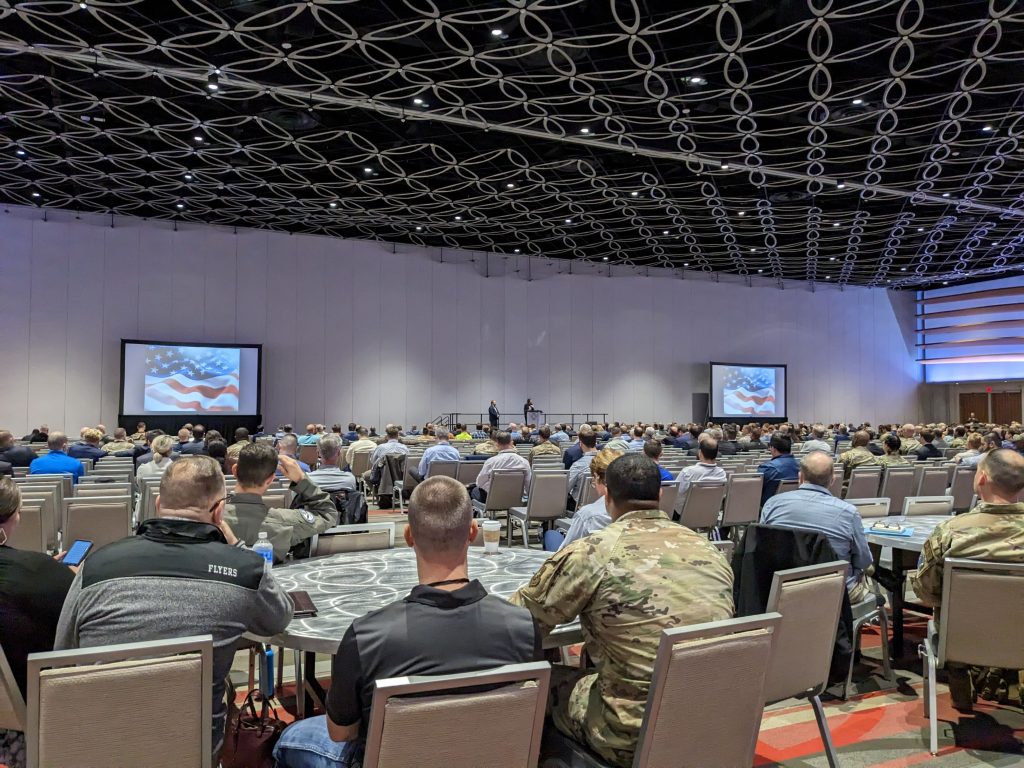
Vigilant Aerospace Systems presented on intellectual property (IP) considerations for companies working with the U.S. Department of Defense (DoD) during AFWERX Industry Days, focusing on the policies, agreement structures, and licensing issues that shape defense technology partnerships.
The presentation addressed how innovative companies entering defense programs must evaluate data rights, software deliverables, patent rights, and agreement terms early in the acquisition process. For companies developing advanced aerospace technologies, these issues can affect long-term product development, sustainment, competition, and future commercialization.
DoD Agreement Structures and IP Planning
A central theme of the presentation was the need to understand how the DoD approaches IP acquisition and management. Under DoD policy, the government generally seeks to obtain the IP deliverables and license rights necessary to support program objectives without acquiring more rights than required. That framework is intended to balance government needs with the private sector’s interest in protecting technology developed through internal investment.
The session reviewed several common agreement structures used in DoD collaborations. These include procurement contracts governed by the Federal Acquisition Regulation (FAR) and the Defense Federal Acquisition Regulation Supplement (DFARS), as well as cooperative agreements, grants, Other Transaction Authority agreements (OTAs), and Cooperative Research and Development Agreements (CRADAs).
For companies entering these arrangements, agreement type matters. Each structure can carry different expectations related to technical data, software delivery, license rights, reporting requirements, and future use of developed technology. Early alignment with acquisition teams is important when defining deliverables, planning for upgrades, and addressing sustainment responsibilities.
Data Rights and License Terms
The presentation also distinguished between required deliverables and the rights associated with those deliverables. In defense contracting, technical data and software may be delivered to the government under terms that define how the government may use, modify, reproduce, release, or disclose that material.
That distinction is especially important for aerospace and autonomy companies whose competitive value often depends on software, algorithms, integration methods, and system architecture. Careful definition of delivery obligations and licensing terms can help prevent unnecessary transfer of rights while still meeting program requirements.
The discussion emphasized that IP planning is not a secondary legal issue. It is part of core program strategy. For technology developers, those decisions can affect future product versions, dual-use applications, follow-on contracts, and broader market adoption.
Patent Rights Under FAR and DFARS
The presentation also addressed patent rights under FAR and DFARS. In that framework, a “subject invention” generally refers to an invention made by a contractor during performance of a government contract. A “background invention” refers more broadly to contractor-developed intellectual property that may be incorporated into products or services provided during contract performance.
In many cases, contractors may elect to retain title to subject inventions if they meet applicable disclosure and reporting obligations. The government may still receive a nonexclusive license to practice the invention under applicable law and contract terms. If a contractor does not elect to retain title, the government may seek title, while the contractor may retain a license to use the invention.
These distinctions are important for companies commercializing advanced aerospace technologies across both government and non-government markets. Patent rights, data rights, and software rights are related, but they are not interchangeable, and each must be addressed deliberately in defense agreements.
Why These Issues Matter for Aerospace Innovators
For companies developing advanced airspace management, autonomy, and uncrewed aircraft systems (UAS) technologies, IP terms can shape the long-term value of participation in defense programs. A clear understanding of DoD policy and agreement mechanisms can support more effective collaboration while protecting the results of private-sector research and development.
Vigilant Aerospace’s participation in AFWERX Industry Days reflects the growing importance of these issues for companies bringing specialized aerospace technologies into government programs. As defense and dual-use aviation markets continue to expand, IP strategy remains a key part of successful engagement with the DoD.
About AFWERX

AFWERX is the innovation arm of the Department of the Air Force. The organization works with startups, small businesses, nontraditional contractors, and research teams to accelerate the transition of emerging technologies into operational use through challenges, funding programs, events, and industry engagement initiatives.
 Vigilant Aerospace is the leading developer of multi-sensor detect-and-avoid and airspace management software for uncrewed aircraft systems (UAS or drones). The company’s product, FlightHorizon, is based on two NASA patents and uses data from multiple sources to display a real-time picture of the air traffic around a UAS and to provide automatic avoidance maneuvers to prevent collisions. The software is designed to meet industry technical standards, to provide automatic safety and to allow UAS to safely fly beyond the sight of the pilot. The software has won multiple industry awards and the company has had contracts and users at NASA, the FAA, the U.S. Department of Defense and with a variety of drone development programs. Visit our website at www.VigilantAerospace.com