
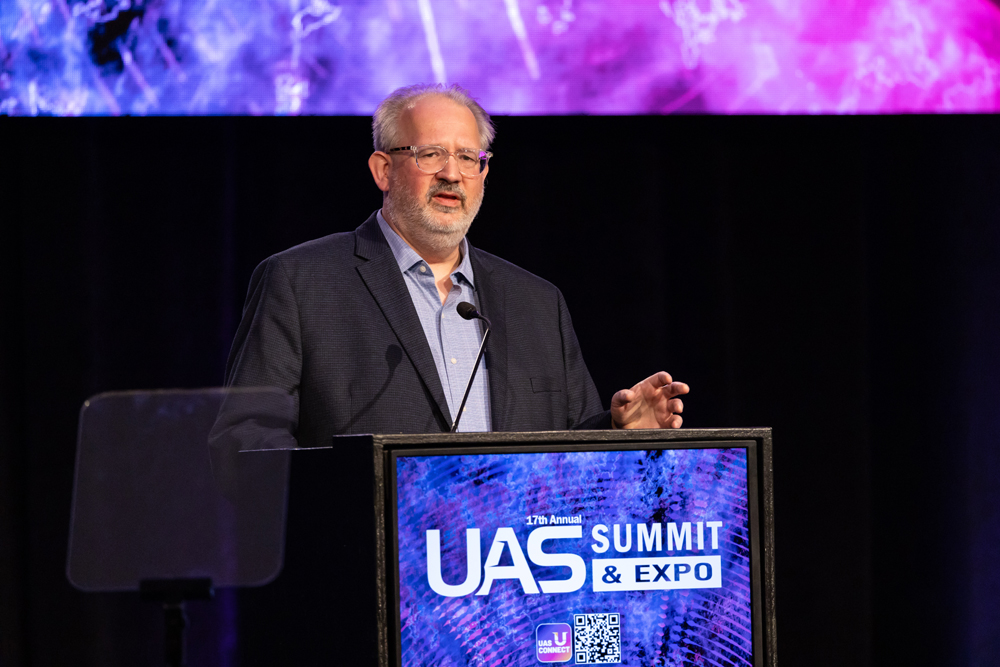
At the 2023 UAS Summit & Expo, Vigilant Aerospace Systems CEO Kraettli L. Epperson outlined how “detect-and-avoid” (DAA) systems are evolving to support large uncrewed aircraft systems (UAS), military platforms, and emerging advanced air mobility (AAM) aircraft. The presentation framed DAA as a practical safety architecture built around a real-time air picture, trajectory prediction, conflict alerting, and avoidance guidance for either remote pilots or autopilots. Epperson positioned this capability as central to beyond visual line of sight (BVLOS) operations, where aircraft need reliable awareness of nearby traffic and the ability to respond early to potential conflicts.
Presentation Highlights
A major theme of the presentation was that these safety requirements are converging across different aircraft categories. Epperson compared three application areas: long-range military drones, air taxis and cargo drones, and hospital delivery networks. While the missions differ, the underlying technical needs are similar: standards-aligned DAA functions, automatic warnings and alerts, data logging, sensor integration, and coordination with broader airspace management systems. The presentation argued that developers are increasingly solving the same core problem across multiple markets, even when the aircraft size, mission profile, and regulatory pathway are different.
Epperson also emphasized that the challenge is not just detecting traffic, but combining distributed inputs into a single, usable decision-making system. The presentation highlighted radar, ADS-B in, Remote ID, telemetry, and networked data services as inputs that must be correlated into an authoritative traffic display. That requires reliable track correlation, common command-and-control assumptions, and compatibility with both pilot-in-the-loop and automatic avoidance modes. In that framing, the future of autonomous safety systems depends as much on systems integration and usability as on any single sensor or algorithm.
The presentation concluded by showing how these overlapping requirements are shaping product development. Epperson pointed to ongoing work in new radar integrations, weather and hazard data, command-and-control models, Remote ID connectivity, portable uncrewed traffic management platforms, and compatibility with military and civilian ground control software. Taken together, the presentation described a maturing DAA market in which scalable, standards-aware safety systems are becoming necessary infrastructure for routine autonomous flight across defense, logistics, and advanced air mobility programs.
Watch the full presentation and read the transcript below.
Full Presentation
About UAS Summit & Expo
The UAS Summit & Expo is an annual industry event produced by BBI International and UAS Magazine. The 2023 event was held October 10 to 11 at the Alerus Center in Grand Forks, North Dakota. Organizers describe it as a long-running gathering for UAS industry leaders, policymakers, researchers, military stakeholders, and commercial operators, with programming focused on the current state and future direction of uncrewed aviation.
 Vigilant Aerospace is the leading developer of multi-sensor detect-and-avoid and airspace management software for uncrewed aircraft systems (UAS or drones). The company’s product, FlightHorizon, is based on two NASA patents and uses data from multiple sources to display a real-time picture of the air traffic around a UAS and to provide automatic avoidance maneuvers to prevent collisions. The software is designed to meet industry technical standards, to provide automatic safety and to allow UAS to safely fly beyond the sight of the pilot. The software has won multiple industry awards and the company has had contracts and users at NASA, the FAA, the U.S. Department of Defense and with a variety of drone development programs. Visit our website at www.VigilantAerospace.com