
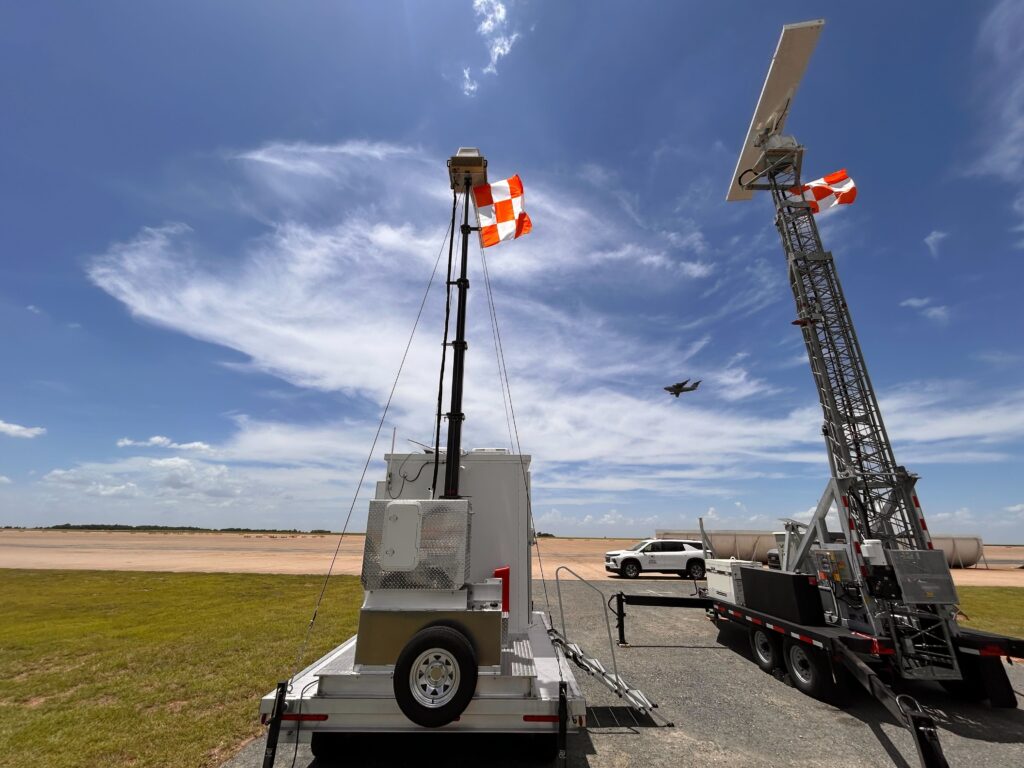
During contract amendment discussion at an Oklahoma Department of Aerospace and Aeronautics meeting, ODAA Executive Director Grayson Ardies outlined the strategic role of Vigilant Aerospace System’s radar-enabled airspace infrastructure at the Burns Flat spaceport.
Ardies described the spaceport as supporting three core activity areas: traditional aviation operations, space-related activity, and uncrewed aircraft systems (UAS). He emphasized that the radar project extends beyond the spaceport itself, with installations planned across western Oklahoma to enable beyond visual line of sight (BVLOS) flight testing. Ardies also spoke about what this system can support in the future, saying
“Once the system is operational and the proof of concept is complete, we expect to offer this capability as a commercial flight test operation serving customers nationwide.”
He noted that demand for flight test infrastructure continues to exceed availability at government-operated ranges, where commercial users often face long wait times and last-minute displacement.
The radar-enabled range, supported by Vigilant Aerospace technology, is intended to offer comparable test capabilities while providing greater scheduling certainty for commercial operators. Ardies positioned the project as a foundation for expanding Oklahoma’s role as a hub for scalable, industry-accessible BVLOS testing and advanced aviation operations.
Watch the video and read the transcript below.
Full Video
Full Transcript
Next is Item 12, a contract amendment with Vigilant Aerospace Systems.
I need to come up with a better acronym than planes, trains, and automobiles, but there are three major components to the spaceport.
First is the traditional aviation side. That includes maintenance, repair, and overhaul, flight testing, flight operations, and military aviation.
Second is the space side, which we just discussed. Don and several other companies will be conducting business there.
Third is the drone side, or the uncrewed aircraft systems side.
The project before you today builds on prior approvals to install radar, not only at the spaceport, but also across western Oklahoma. The purpose is to support beyond visual line of sight flight testing operations.
Our initial operator is expected to be Kratos.
Once the system is operational and the proof of concept is complete, we expect to offer this capability as a commercial flight test operation serving customers nationwide.
We consistently hear from contractors and industry members that government test ranges are fully booked.
In many cases, companies wait up to 18 months for a slot. Even then, if the government needs the range during their scheduled window, commercial users are displaced.
When that happens, testing is not delayed by a week or two. It is often pushed to the end of the line.
Our goal is to provide a commercial range that offers capabilities comparable to government ranges, without the uncertainty caused by competing government priorities.
About Oklahoma Department of Aerospace and Aeronautics
The Oklahoma Department of Aerospace and Aeronautics serves as the lead government agency to support, promote, and advocate for the state’s second largest industry, aviation and aerospace. This includes providing funding, planning, programming and engineering expertise for Oklahoma’s airports and aviation infrastructure as well as ensuring the viability of the aerospace industry. The agency is responsible for the administration and/or coordination of a statewide system of airports, cooperating with and assisting local, state, and federal authorities in the development of aviation infrastructure and facilities, acting as the central resource point in state government for the up-and-coming Unmanned and Advanced Air Mobility sector, and fostering the success of the state’s overall aerospace industry.
 Vigilant Aerospace is the leading developer of multi-sensor detect-and-avoid and airspace management software for uncrewed aircraft systems (UAS or drones). The company’s product, FlightHorizon, is based on two NASA patents and uses data from multiple sources to display a real-time picture of the air traffic around a UAS and to provide automatic avoidance maneuvers to prevent collisions. The software is designed to meet industry technical standards, to provide automatic safety and to allow UAS to safely fly beyond the sight of the pilot. The software has won multiple industry awards and the company has had contracts and users at NASA, the FAA, the U.S. Department of Defense and with a variety of drone development programs. Visit our website at www.VigilantAerospace.com