

Vigilant Aerospace Systems’ FlightHorizon TEMPO deployment at Infinity One Oklahoma Spaceport was recently cited in a Digital ATC Engineering article examining the infrastructure needed to integrate uncrewed aircraft systems (UAS) at non-towered airports. The coverage identifies the deployment as an example of combining radar and transponder data into a shared airspace picture—a capability that supports traffic awareness and conflict detection around uncrewed aircraft operations.
Written by Lieselotte Vanbrabant and published Oct. 24, 2026, the article, “UAS Traffic Management Software Layers for Uncontrolled Airport Digital Infrastructure,” examines three connected functions: flight authorization, surveillance and conflict management. It says in part,
“Vigilant Aerospace’s FlightHorizon TEMPO deployment at the Infinity One Oklahoma Spaceport demonstrates the fusion approach, integrating radar and transponder data into one airspace-management picture for safe autonomous-aircraft testing.”
Connecting Flight Plans With Actual Traffic
The article places Vigilant Aerospace’s deployment within a broader infrastructure challenge: connecting information about planned flights with observations of aircraft actually operating nearby. Authorization addresses whether an operation may proceed. Surveillance provides information about surrounding traffic, while conflict management uses available information to help coordinate operations.
These functions depend on reliable information about nearby aircraft. Combining radar and transponder data into a shared display helps operators monitor traffic, anticipate potential conflicts and make informed decisions during uncrewed aircraft operations.
For operators conducting beyond visual line of sight (BVLOS) flights, coordination between participating drones addresses only part of the traffic environment. The FAA also identifies the need to avoid crewed aircraft, including through detect-and-avoid (DAA) systems evaluated as part of an operational waiver or exemption application. Surveillance and DAA therefore provide information and safety functions that complement strategic coordination between drone operators.
FlightHorizon TEMPO in the Field
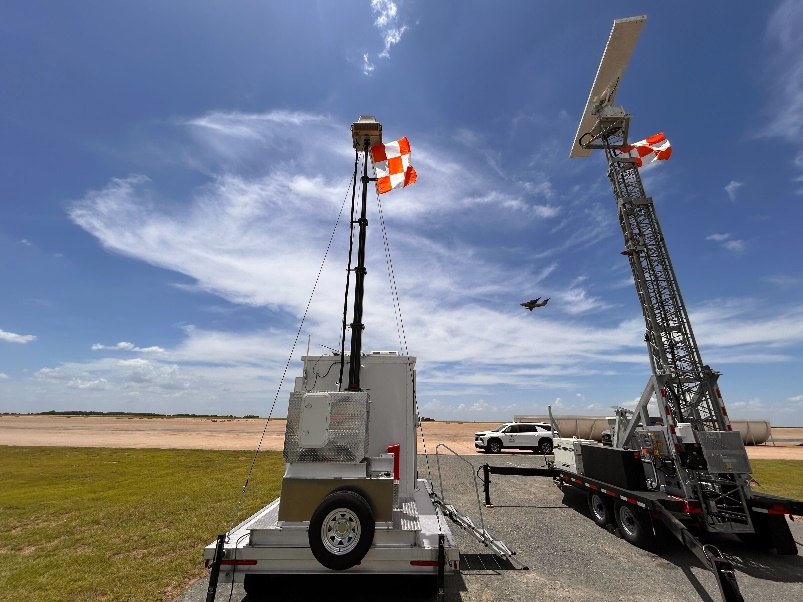
At Infinity One Oklahoma Spaceport in western Oklahoma, FlightHorizon TEMPO brings information from multiple radars, Automatic Dependent Surveillance–Broadcast (ADS-B) receivers and aircraft telemetry into a cloud-hosted airspace picture. The deployment supports airspace management for large UAS development and future autonomous spacecraft operations. Its supporting infrastructure includes redundant power and satellite and fiber-optic connectivity.
FlightHorizon TEMPO is Vigilant Aerospace’s ground-based airspace management and DAA platform. It correlates observations from multiple sources, resolves duplicate aircraft tracks and predicts potential conflicts. Depending on the deployment configuration, its inputs can include radar, ADS-B In, Remote ID and aircraft telemetry. These capabilities allow operators to monitor nearby traffic through a common display.
The software also records airspace activity for replay and review. Those records can help teams examine aircraft encounters, evaluate system performance and prepare supporting information for regulatory submissions. This extends the value of surveillance beyond the immediate traffic display to operational analysis and documentation.
What the Coverage Means for Airport Infrastructure
The Digital ATC Engineering mention positions FlightHorizon TEMPO as a field example of the surveillance capabilities relevant to broader UTM infrastructure planning. It connects Vigilant Aerospace’s work at a large aerospace testing site with the information needs facing airports preparing for mixed crewed and uncrewed operations.
For airport operators, the practical relevance is the ability to combine available surveillance inputs, identify potential conflicts and preserve records within one operating environment. Those functions can support planning for more complex operations alongside the authorization processes, operating procedures and coordination services appropriate to each site.
Read the full article here.
About Digital ATC Engineering
Digital ATC Engineering is a technical publication covering digital and remote air traffic control infrastructure. Its coverage includes sensors, algorithms, controller interfaces, system architecture, certification pathways and safety considerations for non-towered airports.
About Infinity One Oklahoma Spaceport
Infinity One Oklahoma Spaceport is a spaceport and industrial park in Burns Flat, Oklahoma. Its facilities include a 13,503-foot primary runway and infrastructure supporting aviation, aerospace development and reusable launch vehicle operations
 Vigilant Aerospace is the leading developer of multi-sensor detect-and-avoid and airspace management software for uncrewed aircraft systems (UAS or drones). The company’s product, FlightHorizon, is based on two NASA patents and uses data from multiple sources to display a real-time picture of the air traffic around a UAS and to provide automatic avoidance maneuvers to prevent collisions. The software is designed to meet industry technical standards, to provide automatic safety and to allow UAS to safely fly beyond the sight of the pilot. The software has won multiple industry awards and the company has had contracts and users at NASA, the FAA, the U.S. Department of Defense and with a variety of drone development programs. Visit our website at www.VigilantAerospace.com