
FlightHorizon PILOT-C Features
FlightHorizon PILOT-C is an onboard automatic detect-and-avoid (DAA) system for commercial uncrewed aircraft systems (UAS). It correlates data from multiple sensors to detect, track, predict, and help avoid mid-air collisions.
The system can provide resolution advisories to a pilot interface or Ground Control Station (GCS), supporting BVLOS operations and safety case development for commercial missions.

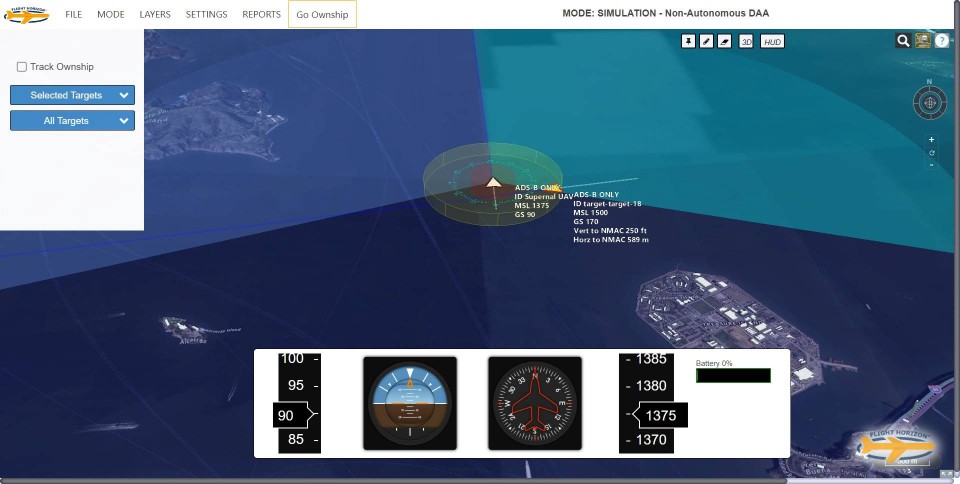
Onboard DAA
FlightHorizon PILOT-C runs onboard the aircraft, so detect-and-avoid decisions are made using direct sensor inputs without relying on ground infrastructure.
-
Connects directly to onboard telemetry, ADS-B In, and radar through aircraft network interfaces
-
Maintains a real-time air picture and advisories on the aircraft with minimal latency
-
Continues operating with onboard processing even when external connectivity is limited
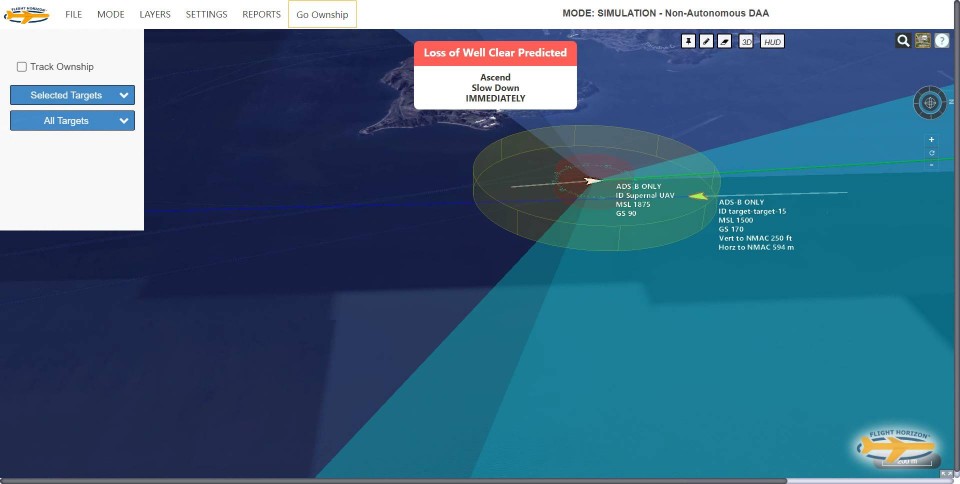
Loss of Well Clear Alerting & Advising
FlightHorizon PILOT-C continuously evaluates nearby traffic against “well clear” thresholds and alerts the operator when separation margins are at risk.
-
Detects projected loss of well clear based on relative position, altitude, and closure rate
-
Issues prioritized cautions and warnings to focus attention on the highest-risk traffic
-
Provides pilot-in-the-loop resolution advisories to support timely, informed maneuver decisions
Conflict Detection and Advisories
FlightHorizon PILOT-C helps operators maintain separation by detecting nearby traffic and generating advisories.
-
Detects and tracks nearby aircraft to help prevent conflicts
-
Calculates collision risk and generates resolution advisories
-
Supports guidance for remote pilots and optional autopilot integration
Onboard Sensor Integration
- Designed for aircraft that support non-cooperative traffic sensors
- Supports integration with multiple ADS-B in receiver and transponder models
- Connects via Ethernet and/or USB for flexible installation and interfacing
-
Commercial BVLOS Readiness
-
Supports safety case development for BVLOS operations and waiver packages
-
Helps document detect-and-avoid behavior for approvals and reviews
-
Aligns configuration with defined airspace rules and mission procedures
Onboard Installation and SWaP-C
-
Compact, low-power DAA computer suited for onboard installation
-
Economical size, weight, power, and cost (SWaP-C) for onboard deployment
-
Configurable across a range of airframes and operating environments
“Safety-as-a-Service” Delivery Model
-
Draws on operational experience across multiple aircraft and mission profiles
-
Reduces integration complexity with a proven onboard DAA architecture
-
Lowers delivery risk by using validated system behavior and repeatable processes
Traceable Logging For Test And Review
-
Records surveillance inputs and advisory events for post-mission review
-
Supports analysis for training, test reporting, and safety assessment
-
Helps maintain traceability during program evaluation and iteration
Technical Features
Real-Time Traffic Tracking
-
Automatically detects and tracks nearby aircraft
-
Maintains continuous traffic updates for timely awareness
-
Designed for repeatable behavior in dynamic conditions
Pilot-In-The-Loop Advisories
-
Generates resolution advisories for timely maneuvering
-
Prioritizes alerts to surface highest-risk traffic first
-
Supports predictable alert behavior and operator response
Aviation-Grade Hardware
Built around aviation-grade hardware components for operational environments. Supports installation using RTCA DO-160 compliant equipment. Hardware selection is configuration dependent.
Real-Time Processing
Real-time data parsing and queueing supports continuous traffic updates. Designed for consistent, repeatable behavior in dynamic conditions. Helps maintain timely detect-and-avoid awareness.
Prioritized Alerts
Alerting and warnings are dynamically prioritized to surface the highest-risk traffic first. Supports rapid operator response and pilot-in-the-loop decision-making. Designed for predictable alert behavior.
Onboard Data Logging
Logs telemetry, sensor, transponder, and DAA feeds onboard. Supports post-flight review, test reporting, and safety analysis. Output formats depend on configuration.
Modular Sensor Expansion
Modular software add-ons support new sensors and autopilots over time. Designed for platform-specific configurations and growth. Helps reduce rework as requirements evolve.
Standards-Aligned Algorithms
Uses DAIDALUS II algorithms supporting ACAS X, Xu, and sXu concepts. Designed to align with RTCA DO-365C Change 1 and ASTM F3442-25, depending on hardware and configuration. Full compliance is configuration dependent.